-p-500%20(1).png)
Virginia Statute of Limitations on Debt Collection: Complete Guide
Need Help Reviewing Your Account?
Contact UsIf you're staring down an old debt in Virginia, you've probably searched for one clean number: "how many years until this expires?" There isn't one. Virginia's debt-collection deadline depends on what kind of debt you have, what document created it, and what's happened to the account since.
A statute of limitations controls whether a creditor can still win a lawsuit against you. It doesn't erase the balance, stop a collector from calling, or automatically remove the account from your credit report. Those are three separate issues, and confusing them leads to costly mistakes.
This guide walks through Virginia's timelines by debt type, what starts and restarts the clock, and what actually happens once a debt becomes time-barred — including special rules for taxes and judgments.
This article is general information, not legal advice. Debt collection law is fact-specific. Talk to a Virginia-licensed attorney before making a payment or responding to a lawsuit.
Key Takeaways
- Virginia's lawsuit deadline runs three to six years, depending on debt type and written instrument
- A signed written contract generally gets five years; an unsigned or oral agreement gets three
- Partial payments and written acknowledgments can restart the limitations clock
- Time-barred doesn't mean forgiven; the debt can still be reported or voluntarily paid
- Judgments follow a separate, much longer enforcement timeline than the original debt
What Is Virginia's Statute of Limitations on Debt Collection?
A statute of limitations is a deadline for filing a lawsuit. Once it passes, the underlying claim (the creditor's legal right to sue over the debt) becomes time-barred. The debt itself doesn't disappear; the creditor simply loses the ability to win a court judgment forcing you to pay it.
Virginia's general contract-lawsuit rules are set out in Va. Code § 8.01-246. Under that statute:
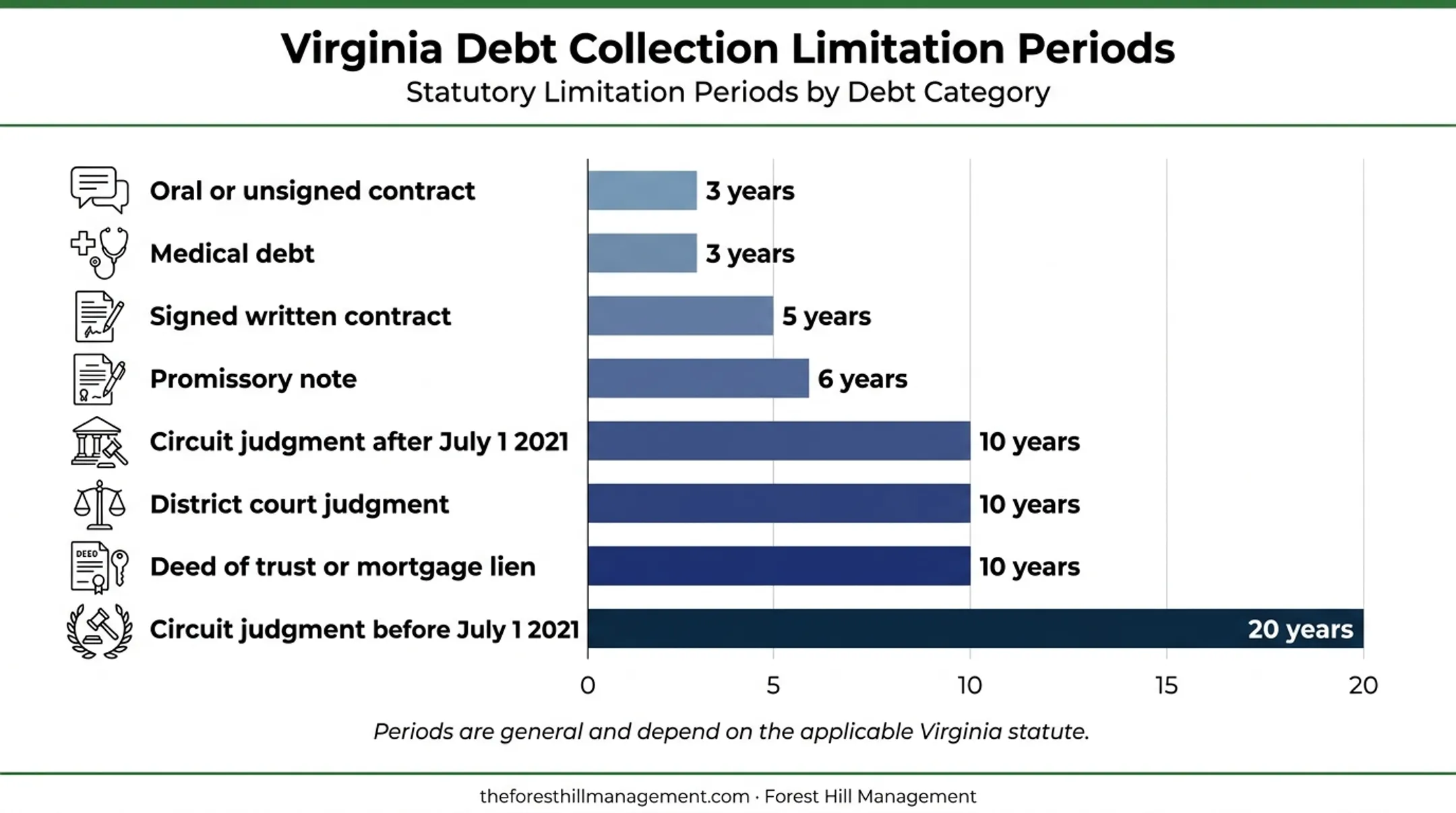
- A written contract signed by the person being charged generally allows five years to sue
- An unsigned written contract or an oral/open-account agreement generally allows three years
The clock typically starts under Va. Code § 8.01-230, which says a contract claim accrues when the breach occurs, not when the creditor discovers the problem or decides to act on it.
Expiration Is a Defense, Not Forgiveness
An expired limitation period gives you an affirmative defense you can raise in court. It doesn't cancel the debt, and it doesn't automatically stop a collector from contacting you or asking for payment.
Account documents, prior lawsuits, and the specific instrument involved can all change the outcome. Verify the current statute and get advice from a Virginia-licensed attorney before you pay anything or respond to a court filing based on assumptions about timing.
How Long Can a Creditor Sue for Different Types of Debt in Virginia?
Different debts follow different rules. Below is a general summary. Always confirm against the actual contract, note, or judgment involved.
Credit Cards and Open Accounts
Credit cards don't have a dedicated statute. Courts treat them as an open account under the contract that governs them. If the cardholder agreement qualifies as a signed written contract, the five-year period may apply; if not, three years is more likely. The card issuer's agreement and how the account was structured both matter. Don't assume every card follows the same rule.
Auto Loans, Mortgages, and Secured Debt
A lawsuit for money owed is a different legal action than foreclosure or repossession. An auto loan or mortgage might involve:
- A promissory note, which follows § 8.3A-118's six-year rule
- A deed of trust lien, enforceable for roughly 10 years under § 8.01-241
- A deficiency balance after repossession, which is typically pursued as a separate contract or note claim
These aren't interchangeable. The remedy a creditor seeks (money, foreclosure, or repossession) determines which rule applies.
Medical Debt's Specific Rule
Virginia's medical-debt provision under § 8.01-246(B) generally requires a covered contract claim to be filed within three years of the final invoice's due date. Payment-plan terms can extend this, and a breach of a qualifying payment plan restarts a three-year window from the breach date. Verify the invoice date and any payment agreement before assuming the standard rule applies.
Judgment Enforcement Periods
Once a creditor wins a lawsuit, the debt becomes a judgment, and § 8.01-251 governs enforcement, not the original contract statute. Judgments dated before July 1, 2021 generally get 20 years; those on or after that date generally get 10 years, with possible extensions through recorded certificates. This is a substantially longer window than most original consumer debts.
When Does the Virginia Debt-Collection Clock Start, Stop, or Restart?
The date the limitation period begins (the accrual date) isn't always obvious. The clock might start at:
- A missed payment or breach of contract terms
- The final invoice due date for medical debt
- A note's stated or accelerated maturity date
- The last payment or charge on an open account
Installments vs. Revolving Accounts
Some installment contracts treat each missed payment as a separate potential claim, while others include an acceleration clause that makes the entire balance due immediately once you default. Whether acceleration applies, and when it was triggered, changes which date starts the clock. This is a document-specific question; don't assume.
How Payments and Acknowledgments Affect the Clock
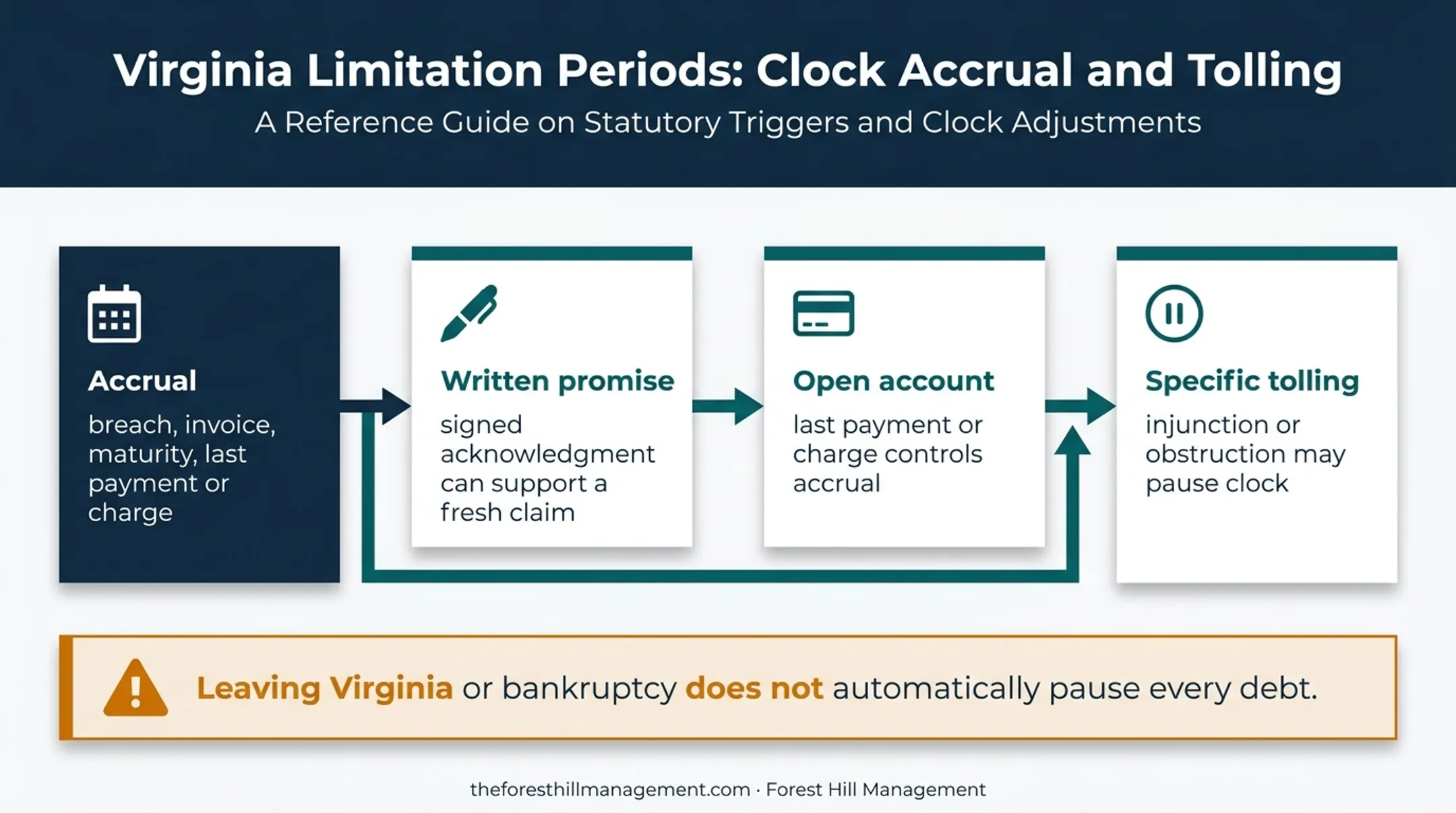
Under § 8.01-229(G), a debtor's signed written promise to pay, or a written acknowledgment implying a promise to pay, can support a new claim within a fresh limitation period. However:
Not every partial payment automatically revives a time-barred debt. The effect depends on the wording, timing, account type, and which statute applies.
For open accounts specifically, § 8.01-249(29) already ties accrual to the last payment or charge, meaning a payment can matter even without triggering the new-promise rule.
Tolling Doesn't Work the Way People Assume
Virginia's tolling statute, § 8.01-229, pauses the clock in specific situations. Examples include a court injunction that blocks filing, or a defendant who actively obstructs service of process.
It does not create a blanket rule that leaving Virginia or filing bankruptcy automatically pauses every debt's clock. Check the specific exception against your facts.
Record-Review Checklist
Before assuming a debt is time-barred, gather:
- The original agreement or note
- Charge-off or default date
- Complete payment history
- Date of last payment
- Written letters, emails, or texts referencing the debt
- Records of account transfers or sales
- Prior lawsuit filings
- Any existing judgment
Example scenario: Someone stops paying a credit card in 2021. In 2024, they make a $50 payment during a phone call with a collector.
That single payment could restart the open-account accrual clock, or support an argument that a new promise was made, depending on what was said and documented. This example is illustrative only.
What Happens After a Debt Becomes Time-Barred in Virginia?
A time-barred debt can still generate mail, phone calls, and settlement offers. What a collector generally cannot do is misrepresent the debt's legal status.
Under CFPB Regulation F § 1006.26, a covered debt collector is barred from suing or threatening to sue on a debt it knows or should know is time-barred. Threatening arrest or implying legal consequences that can't actually happen is also prohibited.
You Must Raise the Defense Yourself
Virginia treats expiration as an affirmative defense under § 8.01-235, meaning you typically must raise it in your response to a lawsuit. It isn't automatic, and a court won't necessarily catch it on its own.
Never ignore a summons. If you're served with a lawsuit:
- Read the deadline and filing instructions on the court paperwork carefully
- File a written response by the stated date
- Raise the statute-of-limitations defense specifically, if it applies
- Get legal advice before the response deadline, not after
Reviewing a Collection Notice
Before responding to any collector:
- Request debt validation in writing, confirming the amount, original creditor, and your dispute rights
- Keep copies of every letter, email, and call log
- Avoid making verbal admissions about the debt's validity or amount until you understand the consequences
Credit Reporting Follows a Different Clock
The Virginia lawsuit deadline and federal credit-reporting rules are unrelated. Under the Fair Credit Reporting Act, negative account information generally stays reportable for up to seven years, regardless of whether the state lawsuit deadline has already passed. A deletion from your credit report doesn't extinguish the debt or a judgment against you.
A Simple Decision Framework
- Confirm the debt: amount, creditor, and account history
- Check for a judgment: a judgment changes everything about enforcement timelines
- Determine whether the limitation period has expired: don't guess
- Weigh your ability to resolve it: through payment, negotiation, or dispute
Forest Hill Management works with consumers and portfolio holders on personalized resolution plans for past-due accounts, including flexible payment options, documentation review, and account clarity. That support can help you organize the practical side of resolving a debt, but it is not a substitute for Virginia legal counsel and does not determine whether a limitation period has expired.
How Do Virginia Consumer-Protection Rules and Special Debts Affect Collection?
Federal and state law both restrict how collectors behave, separately from the limitation-period question.
- The Fair Debt Collection Practices Act (FDCPA) bans harassment, deception, and false threats by covered debt collectors
- The Virginia Consumer Protection Act (§ 59.1-196 et seq.) prohibits related fraudulent practices in consumer transactions, though it excludes certain regulated financial institutions
- Consumers can dispute a debt through a CFPB debt-validation process, generally within 30 days of first contact, and request further proof
Back Taxes Follow a Different System
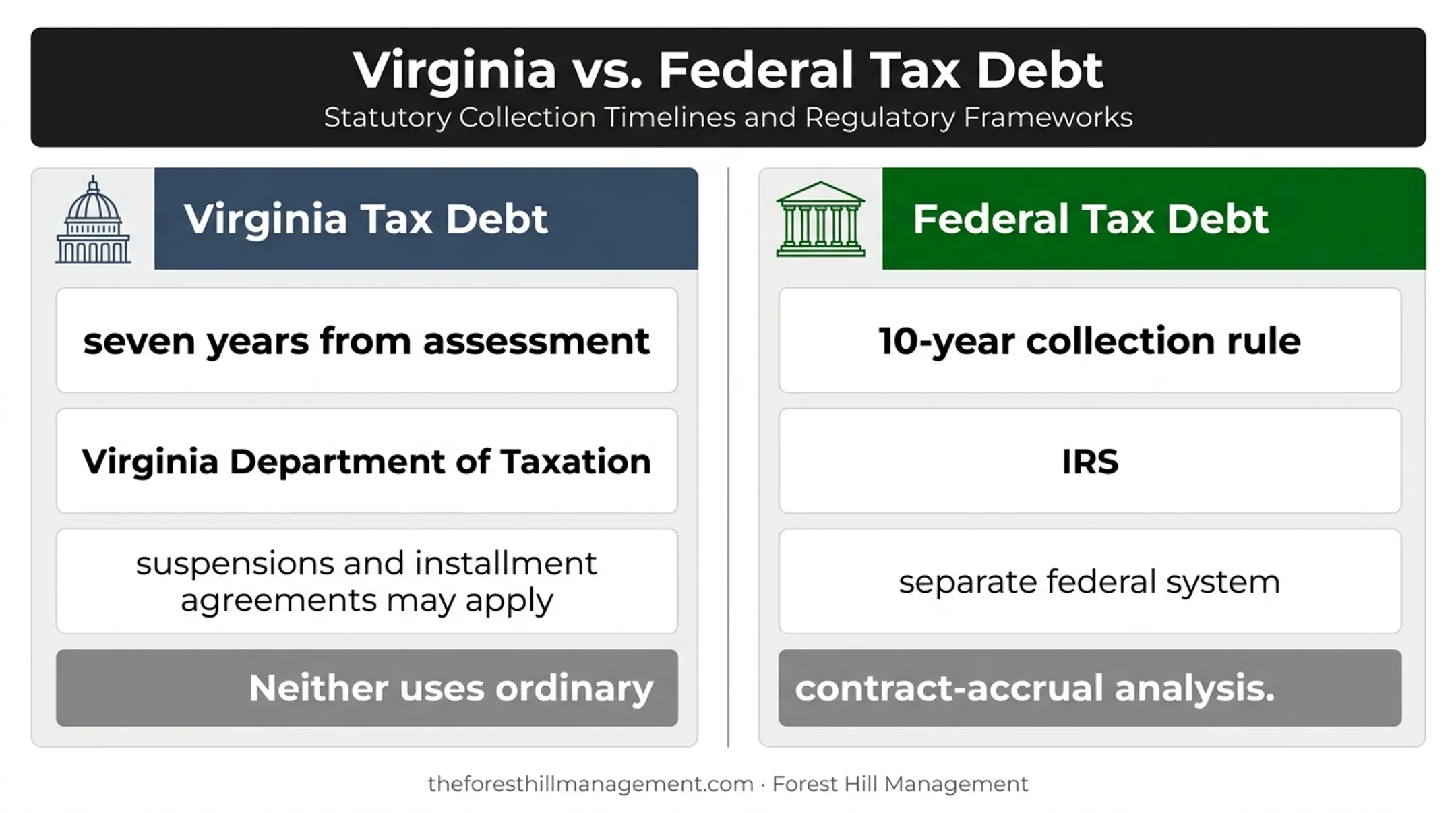
Tax debt isn't handled like consumer debt. Virginia's Department of Taxation generally has seven years from assessment to collect under § 58.1-1802.1, with specific rules for suspensions and installment agreements.
Federal tax debt follows the IRS's own 10-year collection rule. Neither uses the ordinary contract-accrual analysis described earlier. Consult the Virginia Department of Taxation or a qualified tax professional for assessment-specific questions.
Unpaid Debt Is Civil, Not Criminal
Ordinary unpaid consumer debt doesn't lead to incarceration. Ignoring a court order, rather than simply owing money, can trigger separate consequences under Virginia's post-judgment enforcement procedures. Nonpayment alone isn't a crime; disregarding a judge's order can be.
When to Get Help Immediately
Escalate to an attorney or consumer-protection agency if you're facing:
- Suspected identity theft or a debt that isn't yours
- An incorrect balance you can't resolve through normal disputes
- An active lawsuit or existing judgment
- Threats of arrest over unpaid debt
- Uncertainty about whether a payment could affect a limitation defense
Conclusion
Start with the basics, then confirm the clock has not been reset:
- Identify the debt type and the legally relevant date (breach, final invoice, note maturity, or judgment entry).
- Check for payments, written acknowledgments, prior lawsuits, or an existing judgment before assuming anything about timing.
- Verify current Virginia law, since statutes and court rules change.
Time-barred doesn't mean erased. Don't ignore a summons, and don't assume a credit-report deletion resolves the underlying obligation.
If you're working through a past-due account, Forest Hill Management helps consumers and businesses navigate resolution options for outstanding obligations without claiming to provide legal representation. For a specific limitation-period question or an active lawsuit, talk to a Virginia-licensed attorney first.
Frequently Asked Questions
What is the statute of limitations for debt collection in Virginia?
There's no single deadline. Virginia uses different periods, generally three to six years or more, depending on the debt type and instrument. Check the specific Virginia Code section that applies to your situation.
What is the statute of limitations for credit card debt in Virginia?
Credit cards are typically treated as open accounts under the cardholder agreement. The limit is generally three or five years, depending on whether that agreement qualifies as a signed contract. Verify the period and any payments before relying on a specific number.
How long can the state of Virginia collect back taxes?
Virginia generally has seven years from assessment to collect state tax debt, separate from consumer-debt rules. Contact the Virginia Department of Taxation or a tax professional for your specific assessment history.
Should I pay a debt that's past the statute of limitations in Virginia?
A payment or acknowledgment can affect the legal analysis, sometimes restarting the clock. Verify the debt and seek advice before paying, settling, or making any promise to pay.
Can you walk away from debt in collections in Virginia?
Don't ignore valid notices or a lawsuit. Review the debt, request validation, dispute inaccuracies, and evaluate lawful resolution options with guidance if needed.
Can you go to jail for unpaid debt in Virginia?
Ordinary unpaid consumer debt is a civil matter, not a criminal one. Ignoring a court order or failing to respond to legal process can still create separate consequences. Always respond to official court documents.