-p-500%20(1).png)
Statute of Limitations for Debt Collection in Michigan
Need Help Reviewing Your Account?
Contact UsMost Michigan consumer debts fall under a six-year statute of limitations for lawsuits, but the exact deadline depends on the type of debt, the contract terms, and what happened in the account's history. There's no single date that applies to every situation.
Here's the part many people miss: an expired limitations period stops a creditor from suing you. It doesn't erase the debt, stop a collector from calling, or guarantee anything disappears from your credit report. Those are separate legal tracks entirely.
This guide walks through how to find the dates that matter, what makes medical debt trickier than other accounts, how partial payments can affect your position, and what to do if you're served with a lawsuit or contacted about an old balance.
Key Takeaways
- Michigan's six-year rule is a starting point, not a final answer, for most contract-based consumer debts
- Statute of limitations and credit-reporting timelines follow different laws—don’t treat them as the same clock
- Never make a payment or written acknowledgment on old debt without checking your account history first
- A summons requires a response, even if you believe the debt is time-barred
- Keep every account document; you'll need it to build an accurate timeline
What Is the Statute of Limitations for Debt Collection in Michigan?
A statute of limitations sets the deadline for filing a lawsuit. It doesn't touch the debt's existence, a collector's right to ask for payment, credit reporting, or your ability to settle voluntarily. Those all operate under separate rules.
Under MCL 600.5807(9), Michigan sets a six-year window for breach-of-contract claims that aren't covered by a more specific statute. This is the provision most consumer debts fall under, but "most" isn't "all."
How Different Debt Types Are Classified
The six-year rule generally applies to:
- Credit card balances
- Personal loans
- Medical accounts billed under a service agreement
- Auto loan deficiencies (in most cases)
- Written and oral contracts
- Open-ended revolving accounts
Promissory notes deserve a closer look. A common myth claims every private note gets ten years. That's not accurate.
The ten-year period in MCL 600.5807(8) applies to notes tied to specific public entities, not an ordinary consumer note between you and a lender. A private note typically falls under the standard six-year contract period, though the specific language matters.
The Defense Isn't Automatic
Filing a lawsuit after the deadline doesn't make the case disappear on its own. A judge won't dismiss a time-barred claim automatically. The consumer has to raise the statute-of-limitations defense, usually in a written Answer to the complaint, according to Michigan Legal Help. Miss that step, and the defense can be lost.
A time-barred debt differs from these situations, and each needs different handling:
- Paid debt — already resolved, but confirm it's reflected accurately
- Discharged in bankruptcy — legally eliminated, different from expiration
- Disputed as inaccurate — the amount or ownership is in question
- Reduced to judgment — a court already ruled, and different rules apply to enforcement
When Does the Michigan Debt-Collection Clock Start, Pause, or Restart?
The clock doesn't start when you opened the account or received your first bill. It starts when the claim accrues, typically the date of default or the date a payment was missed and not cured. For installment accounts, MCL 600.5836 treats each missed payment as its own accrual event, unless the contract has a valid acceleration clause that makes the entire balance due at once.
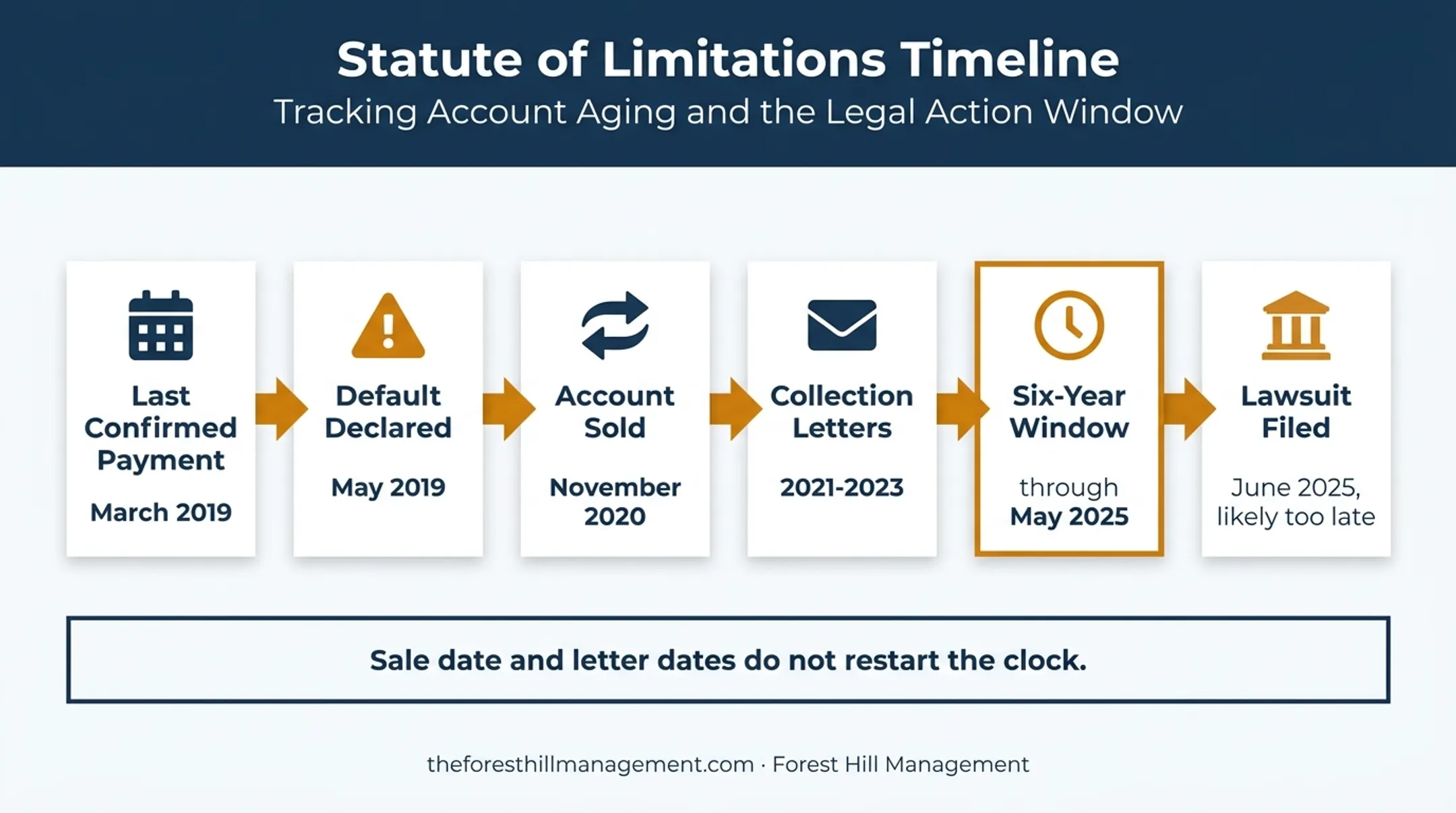
A Sample Timeline
A simple example shows how accrual works in practice:
- Last confirmed payment: March 2019
- Default declared: May 2019 (after a missed payment cycle)
- Account sold to a debt buyer: November 2020
- Collection letters sent: 2021–2023
- Lawsuit filed: June 2025 In this scenario, the six-year clock likely started at default in May 2019—not when the account was sold or when letters went out. Six years from May 2019 runs through May 2025, so a suit filed in June 2025 would likely be too late unless a different accrual date applies.
What Can Pause or Restart the Clock
A few legally recognized events affect the timeline:
- Absence from Michigan: Under MCL 600.5853, absence over two months at a time can toll the clock unless the creditor still had adequate means to serve you.
- Fraudulent concealment: MCL 600.5855 opens a two-year window from discovery if the creditor’s identity or the claim was fraudulently hidden.
- Written acknowledgment: A time-barred debt revives only through a signed written acknowledgment or promise under MCL 600.5866. A verbal promise does not count. Here's where people get into trouble: a payment or a phone admission that you owe the debt can feel harmless, yet it may support a revival argument or muddy your defense later. Before you discuss an old account with a collector, confirm whether the limitations period has already run.
Judgments Play by Different Rules
Once a creditor wins a lawsuit, the debt becomes a judgment. Judgments are not measured on the original contract clock. Under MCL 600.5809, a Michigan court-of-record judgment generally lasts ten years from entry, and creditors can often file a new action to extend enforcement. That runway is much longer than the six-year contract deadline—which is why avoiding a default judgment matters so much.
Which Types of Debt Need Special Attention?
Not every debt fits neatly into the six-year framework. Medical bills, secured loans, and a handful of other categories come with their own wrinkles.
Medical Debt Complications
Medical accounts are rarely straightforward. Insurance adjustments, billing corrections, and payment plans can all shift when a claim actually accrues.
Under MCL 500.2006, health plans generally must pay a clean claim within 45 days, and providers typically have up to a year to submit a clean claim to insurance. But these are provider-to-insurer rules. They don't set a blanket deadline for billing you, the patient.
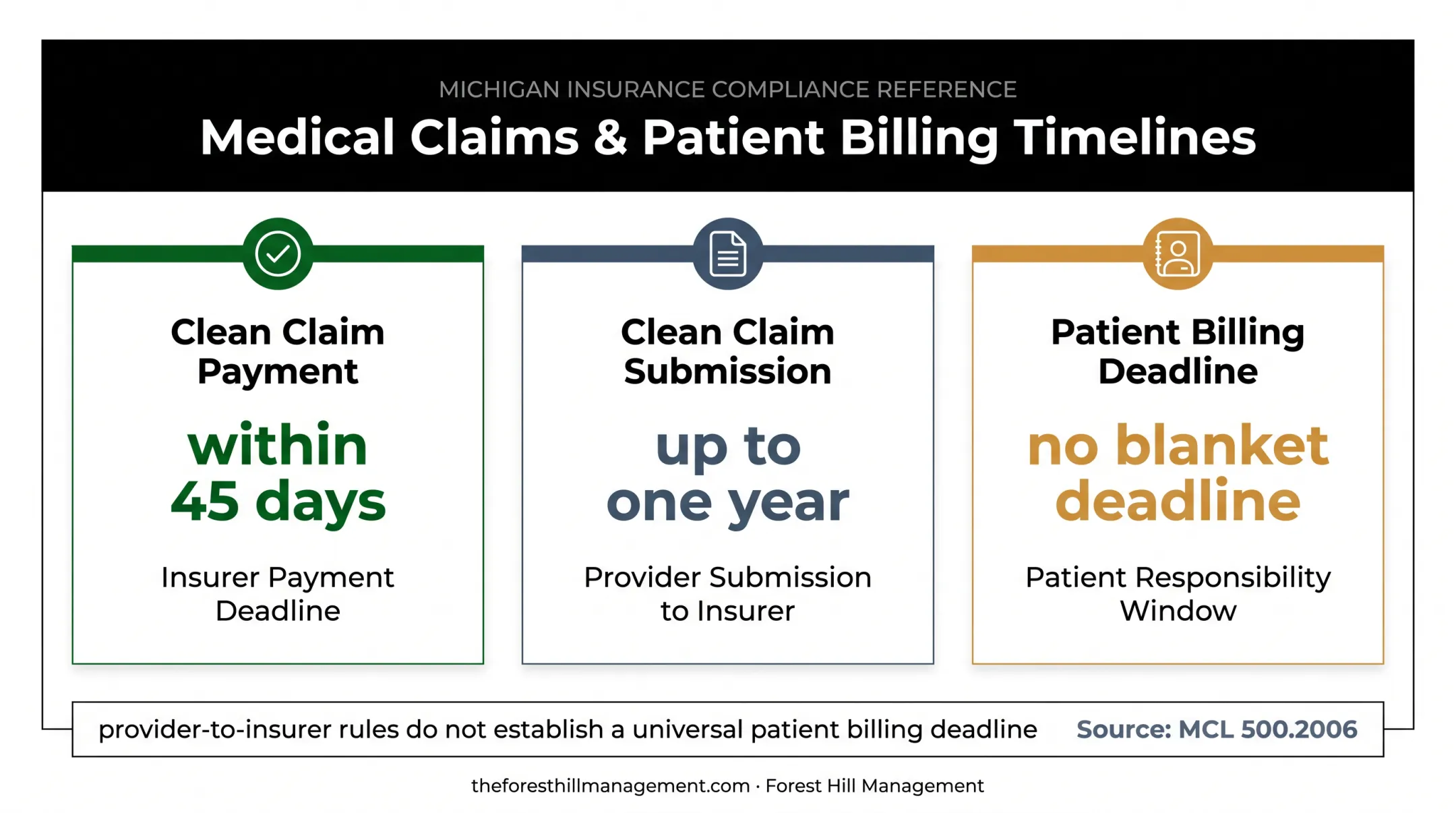
A doctor billing you two years later isn't automatically wrong or automatically expired. It depends on:
- Whether the delay came from insurance reprocessing
- If the balance reflects a corrected claim
- What your provider agreement says about billing timelines
- When the claim legally accrued under your specific contract
Secured Debt and Other Exceptions
Auto loans, mortgages, and student loans follow different mechanics than a standard credit card balance:
A Quick "Do Not Assume" Checklist
- Not every debt automatically gets six years
- A debt buyer's purchase date does not restart the clock
- Collector-claimed balances and account histories need independent verification
- Delayed medical bills are not invalid solely because they arrived late
How to Determine Whether a Michigan Debt May Be Time-Barred
Figuring out where your account stands takes some legwork, but it's manageable if you're organized.
Gather Your Documents
Start collecting:
- The original agreement or contract
- Account statements and payment history
- Any settlement correspondence
- Collection letters and validation notices
- Credit report entries related to the account
- Court documents, if any exist
Preserve originals, keep envelopes that show mailing dates, and do not alter any documents. If a call matters, note the date, time, and what was said.
Build a Timeline
Lay out these dates side by side:
- Last confirmed payment
- First missed payment or default
- Any written acknowledgment you may have signed
- Assignment or sale to a debt buyer or collection agency
- Lawsuit filing date (if applicable)
- Date you were served
Compare this timeline against the applicable Michigan limitations period. A credit report date is not the same thing as the statute-of-limitations date. Check a collector's claimed "date of last payment" against your own records instead of taking it at face value.
Respond to Validation Notices
If you receive a validation notice, you generally have 30 days to dispute the debt in writing under federal debt-validation rules. Use that window to confirm account dates and request supporting records before you reply.
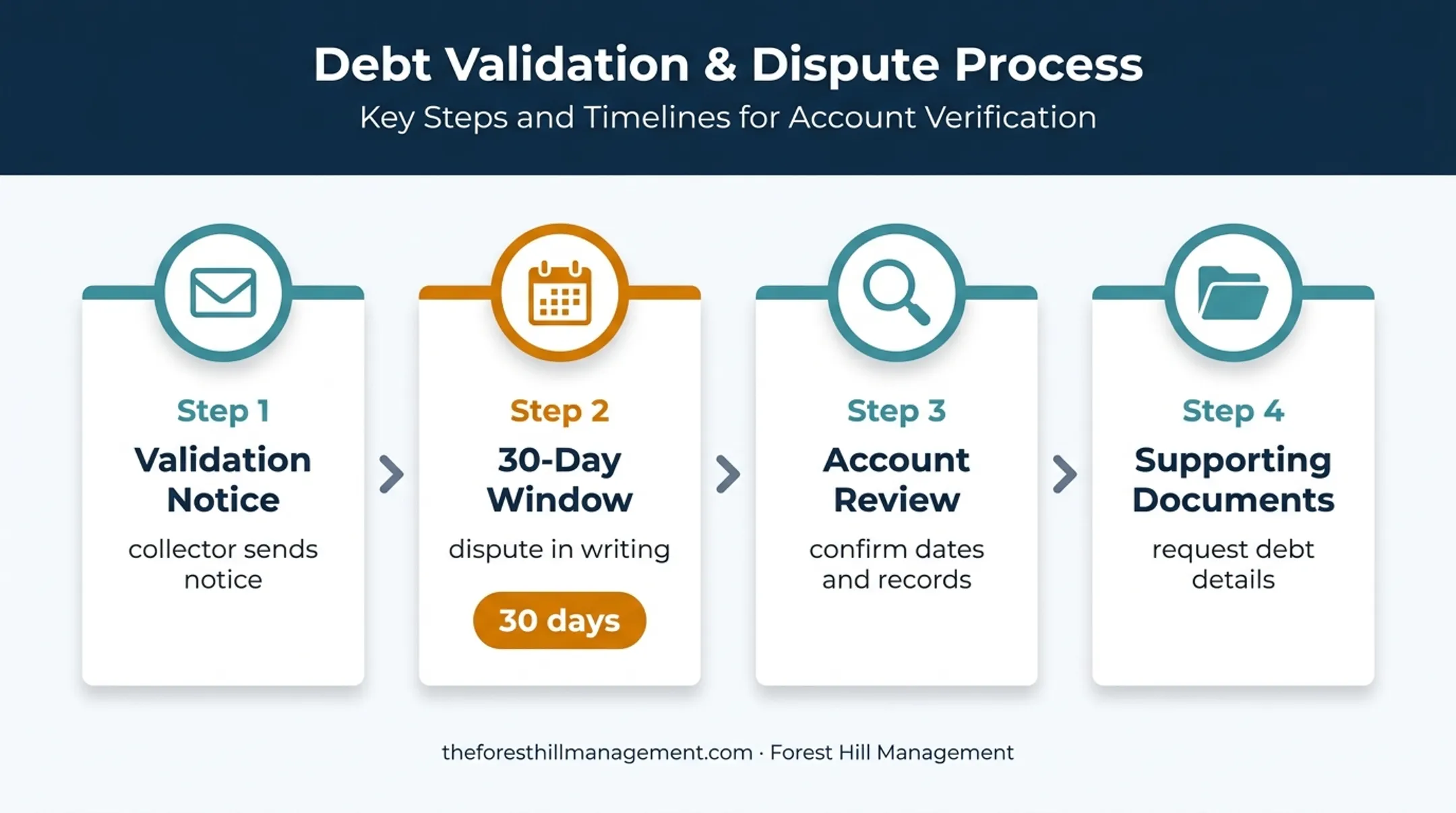
Forest Hill Management's debt-verification process is one example of what consumers can request, what may pause during review, and which documents are returned in response—useful context even when another company holds the account.
What Should You Do If a Collector Contacts You About Old Debt?
A collector can often still ask for payment on an old account, but the contact has to stay within legal boundaries. It cannot include misleading threats about a lawsuit or misrepresent the debt's legal status.
A Measured Response Beats a Rushed One
Before you agree to anything or say anything at all:
- Don't volunteer admissions, promises, or payments before reviewing your account history
- Request validation information if you haven't already received it
- Keep records of every call, letter, or email
- Don't rely on a verbal assurance from a representative as your only proof of anything Understand the difference between these actions, because they carry different consequences:
- Disputing the debt: challenges accuracy or ownership
- Requesting validation: asks the collector to prove the debt and its details
- Asking communications to stop: limits future contact, but doesn't erase the debt
- Negotiating a settlement: resolves the balance, often for less than owed
- Asserting a statute-of-limitations defense: a legal argument, typically raised in court
A Summons Is Not a Collection Letter
This distinction matters. A summons or complaint identifies a court, a case number, a response deadline, and instructions for filing an Answer. Ignoring it, even when the debt feels old, can lead to a default judgment, according to Michigan Legal Help. Once that happens, the creditor may be able to pursue garnishment, even if the underlying debt might have been time-barred. If you're served, get qualified legal help promptly. A defendant typically raises affirmative defenses, including expiration, in the written Answer by the deadline listed on the summons. If you have a past-due account and want to review your documented balance or resolution options, contact Forest Hill Management using the phone number or email on your account correspondence. Forest Hill Management's complaint process separates requests like disputing a debt from asking communications to stop, so you can choose the path that fits. Forest Hill Management does not determine legal deadlines and is not a substitute for advice from a Michigan attorney.
Michigan Collection Protections and Resolution Options
Both federal and state law limit what a collector can do when pursuing a debt.
What's Prohibited
The Fair Debt Collection Practices Act and Michigan's Regulation of Collection Practices Act prohibit:
- Deceptive or misleading representations about the debt
- Harassment or abusive tactics
- Threats of legal action a collector doesn't intend to take, including suing on a time-barred debt
- Contacting you at unreasonable times or places
Documenting Everything
Keep a simple log:
- Date and time of contact
- Caller's name and callback number
- Claimed balance and creditor name
- Any threats or unusual statements
- Copies of letters, emails, and texts
Before recording a call yourself, check Michigan's consent rules; state law generally allows a participant to record their own conversation, but the details matter enough to verify first.
Resolution Options
Once you have a clear record of who contacted you and what they claim, these paths are commonly used:
- Dispute the debt if the balance or ownership is wrong
- Pay in full to close the account outright
- Negotiate a settlement for a percentage of the balance, and get the terms in writing
- Set up a payment plan to spread the balance over time
- Contact nonprofit credit counseling or legal aid for complex situations
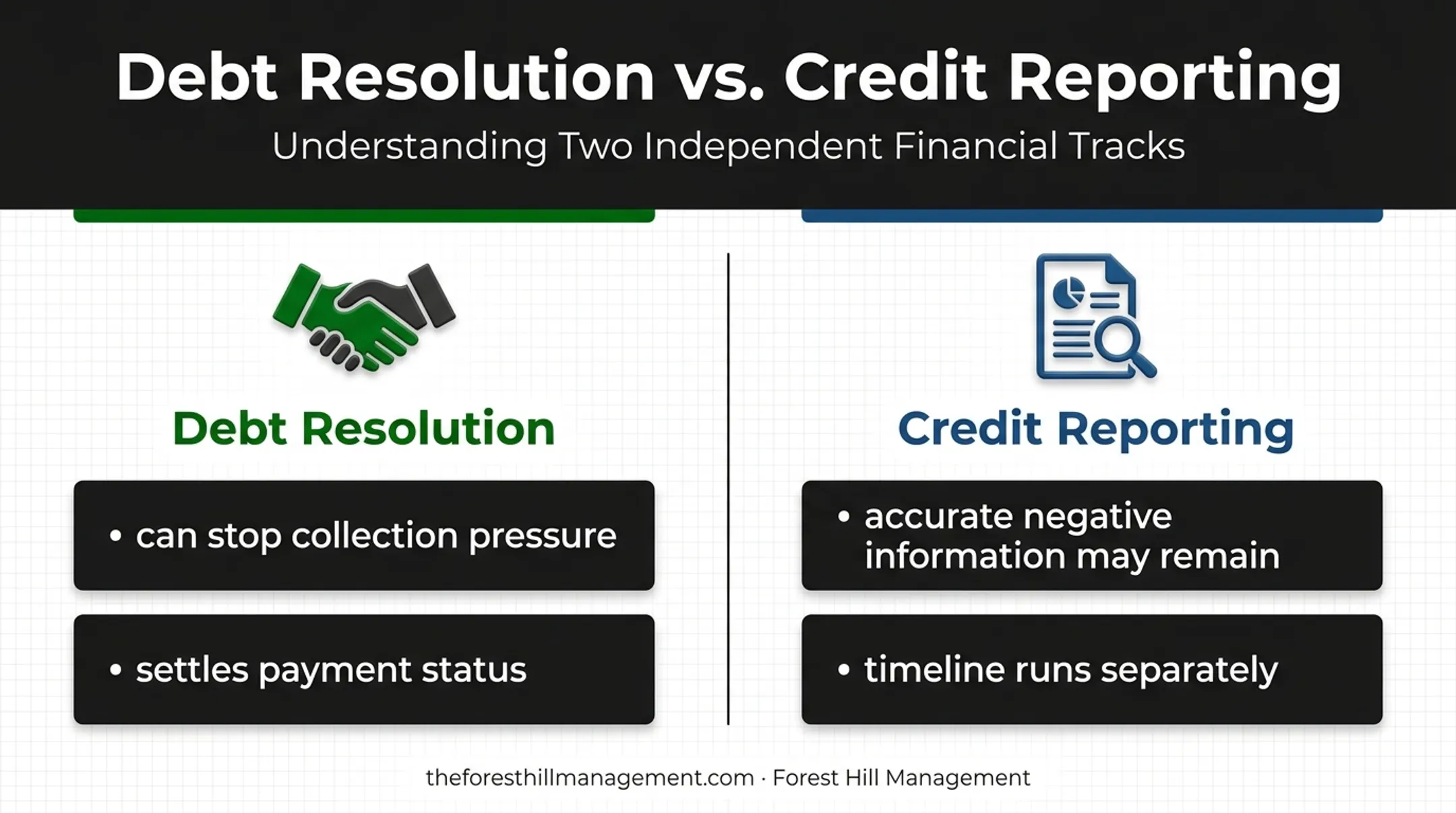
Resolving a debt can stop collection pressure, but it does not automatically remove accurate negative information from your credit report. Reporting timelines run separately from payment status.
Get professional legal help if you are facing:
- A filed lawsuit or default judgment
- Wage or bank garnishment
- A bankruptcy discharge question
- Identity theft
- A confusing medical or secured-debt situation
These matters usually need tailored legal advice, not a generic do-it-yourself fix.
Frequently Asked Questions
How long can a debt collector legally pursue old debt in Michigan?
Most Michigan consumer debts fall under a six-year lawsuit deadline, but the accrual date and account type can shift that. A collector can still request payment outside that window; filing a lawsuit is a separate matter entirely.
Can you walk away from debt in collections?
Ignoring a debt carries risk, including a lawsuit or default judgment if you don't respond to court paperwork. Review your account, understand your rights, and dispute the debt, get legal advice, or work out a resolution instead of assuming it will disappear.
What happens if you don't pay medical bills in Michigan?
Unpaid medical bills can go to collections, appear on your credit report, and potentially lead to a lawsuit. Financial assistance and payment plans may be available, and the applicable deadline depends on your specific provider agreement.
Can a doctor bill you 2 years later in Michigan?
A delayed bill isn't automatically invalid or time-barred. Insurance processing delays, billing corrections, and your provider's contract terms all factor into when the claim actually accrued.
Does Michigan forgive medical debt?
Michigan has no blanket medical-debt forgiveness rule. Some relief may come through charity-care policies, provider assistance programs, insurance corrections, settlements, or bankruptcy, but eligibility depends on the specific circumstances.