-p-500%20(1).png)
Illinois Statute of Limitations on Debt Collection: Complete Guide
Need Help Reviewing Your Account?
Contact UsIf a collector is calling about an old debt, your first question is probably this: can they still sue me? In Illinois, the answer depends on how the debt is classified. State law generally gives creditors five years to sue on an unwritten or open-ended account, and ten years on a written contract or promissory note. But the exact deadline hinges on your specific documents and account history, not a one-size-fits-all rule.
Here's what the statute of limitations does not do. It doesn't erase your balance, stop every phone call or letter, or determine how long a collection shows up on your credit report. Those are separate clocks running on separate timelines.
This guide walks through how to identify your debt type, estimate the relevant date, avoid missteps that could hurt your legal position, respond to collectors, and know when it's time to call an attorney.
Key Takeaways
- Illinois: 5 years to sue on unwritten or open debt, 10 years on written contracts or notes—your records decide which applies.
- The lawsuit deadline, collection-contact rules, and credit-report timeline are three different legal clocks.
- Never ignore a summons, and don't make a payment or sign anything before understanding the consequences.
- Keep every account statement, contract, payment record, and collection letter you receive.
Illinois Statute of Limitations on Debt Collection by Debt Type
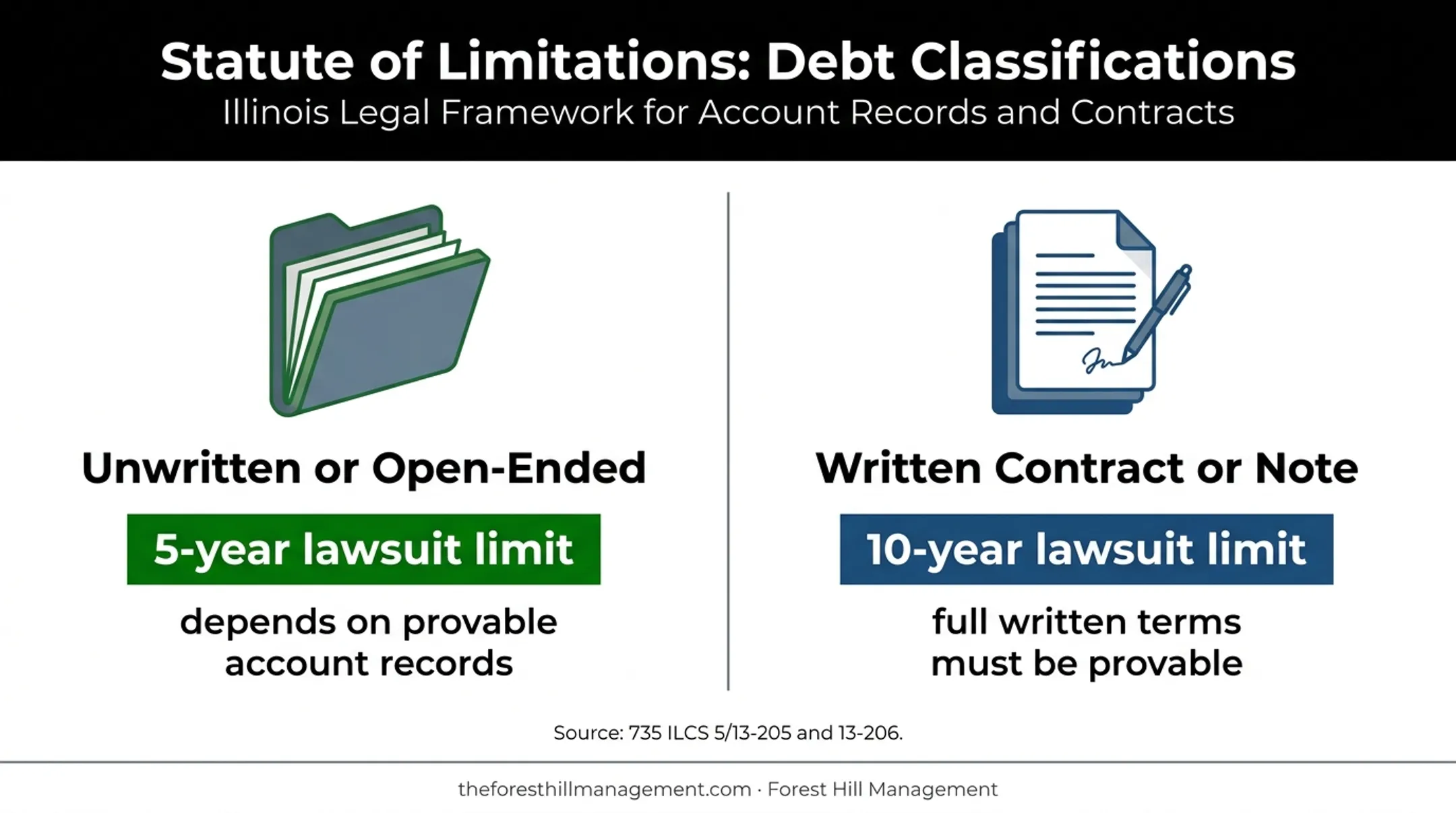
Illinois law splits consumer-debt lawsuits into two main buckets under the Illinois Compiled Statutes:
- Unwritten or open-ended agreements: 735 ILCS 5/13-205 sets a 5-year limit for actions not covered by a more specific statute.
- Written contracts and promissory notes: 735 ILCS 5/13-206 sets a 10-year limit.
These aren't universal labels tied to a debt type. They're tied to what the creditor can actually prove.
Credit Cards Aren't Always "5-Year" Debt
Credit card debt is usually treated as an open-ended account, so it lands in the 5-year bucket. That outcome is not automatic.
In Portfolio Acquisitions, L.L.C. v. Feltman, an Illinois appellate court applied the 5-year period because the creditor couldn't produce a complete written agreement establishing the account's terms. If a creditor can prove a full written contract exists, the 10-year period may apply instead.
Translation: two people with card debt from the same issuer could have different deadlines depending on what paperwork exists.
Other Common Consumer Debts
The statute of limitations only governs whether a creditor can win a court judgment. It says nothing about whether the debt still exists or whether you can resolve it voluntarily outside court.
This is general information, not legal advice. Limitations questions are fact-specific. Confirm the current statutory language and how it applies to your account before assuming any date is accurate.
How the Illinois Limitations Period Starts, Ends, or Changes
What Date Actually Starts the Clock?
People often assume the clock starts when they opened the account. It doesn't. Illinois law counts from the date the cause of action accrued. That is typically the date of default, the first missed payment that wasn't cured, or—for notes with a fixed due date—the date in the note (or an acceleration date, if the creditor invoked one). For revolving accounts, the Federal Trade Commission notes that a missed payment is usually the event that starts the clock. But "usually" isn't "always." Your specific account terms control.
A Step-by-Step Way to Check Your Date
- Identify the creditor and account. Confirm who currently owns the debt versus who originally issued it.
- Get your contract and account history. Request the original agreement and full payment record.
- Locate the default date. Find the last payment made and the date the account went unpaid.
- Classify the debt. Determine whether it's a written contract, promissory note, or unwritten account.
- Check for later agreements. Look for any settlement, payment plan, or acknowledgment signed after the original default.
- Compare against any lawsuit filing date. If you've been sued, check whether the filing date falls inside or outside the applicable period.
Payments, Promises, and What Might Reset the Clock
Under 735 ILCS 5/13-206, a written payment or new promise to pay on a qualifying written instrument can open a new 10-year period measured from that payment or promise. This is not a blanket rule for every unwritten account or verbal statement. The specific statutory language and your debt's classification determine whether it applies. Before any payment on an old debt, understand how it could affect your legal position.
Complications That Can Pause or Extend a Deadline
Several factors can change the calculation. Verify each one under Illinois law:
- Bankruptcy filings that pause collection activity and deadlines
- The debtor's absence from the state
- Legal incapacity
- Prior litigation on the same debt
- Contractual choice-of-law clauses
- A prior judgment, which follows separate enforcement rules
Filing a Lawsuit vs. Winning It vs. Collecting On It
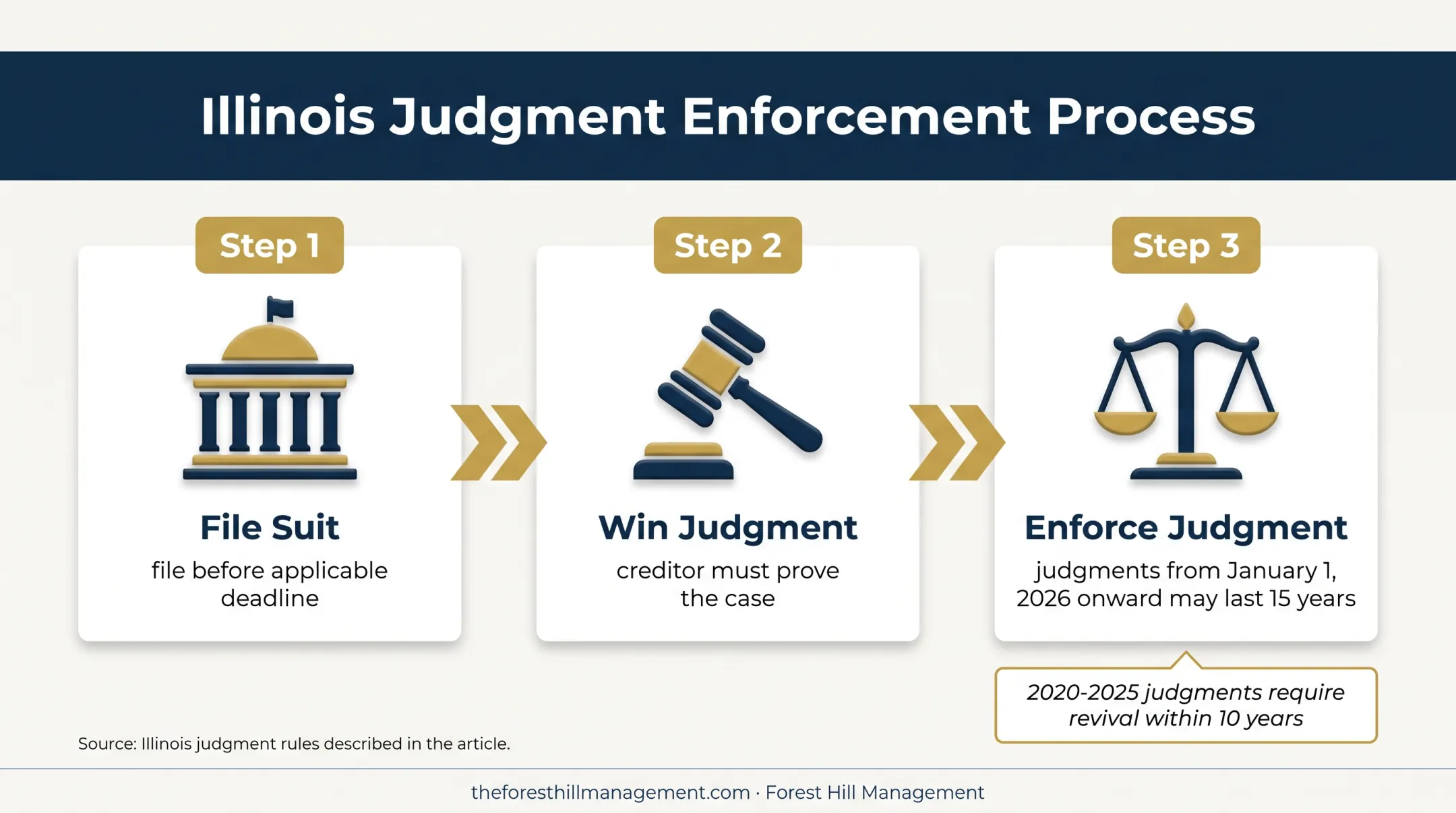
Filing suit before the deadline is only step one. A creditor still has to win the case and obtain a judgment. Enforcement is a separate timeline after that. Judgments entered from January 1, 2026 onward may be enforceable for 15 years with no revival option. Judgments entered between 2020 and 2025 required a revival petition within 10 years. Older judgments follow different pre-2020 rules. Accrual and filing dates are what usually decide a time-bar defense. Hypothetical example (for illustration only): Someone defaults on a credit card on March 1, 2019, with no written agreement setting full terms. Under a 5-year period, a suit filed after March 1, 2024, could be challenged as time-barred. This is a simplified illustration only—not a calculation for any real account.
What Happens When the Illinois Statute of Limitations Expires?
Time-Barred Doesn't Mean Debt-Free
A "time-barred" debt is one where the deadline to sue has passed. That's a defense you can raise in court. It does not automatically cancel the balance, erase the account, or stop it from showing up on your credit report.
Time-barred debt is different from:
- Discharged debt (eliminated through bankruptcy)
- Forgiven debt (the creditor voluntarily cancels it)
- Deleted credit-report information (removed under FCRA timing rules)
- Disputed debt (you're contesting accuracy, not just timing)
- Debt you never actually owed (no valid obligation existed)
Collectors Can Still Contact You, Within Limits
A collector may still reach out about a potentially time-barred debt. Under Regulation F, a covered debt collector cannot sue or threaten to sue on debt it knows, or should know, is time-barred. This prohibition applies even if the collector claims it didn't realize the deadline had passed.
What collectors can't do:
- Threaten legal action they can't legally pursue
- Misrepresent the debt's legal status
- Use deceptive or abusive tactics to pressure payment
Don't Assume a Lawsuit Is Automatically Invalid
Here's a mistake that costs people real money: assuming an old account means a lawsuit can't hold up. The statute of limitations is an affirmative defense. You have to raise it.
If you ignore a summons because you think the debt is too old, a court can enter a default judgment against you anyway. Once that happens, the creditor may pursue wage garnishment or bank account levies, subject to Illinois procedures and exemptions.
Credit Reporting Runs on a Different Clock
The Fair Credit Reporting Act generally allows collection accounts to remain on a credit report for about seven years, starting roughly 180 days after the delinquency that led to collection. That timeline has nothing to do with Illinois's lawsuit deadline. A debt can:
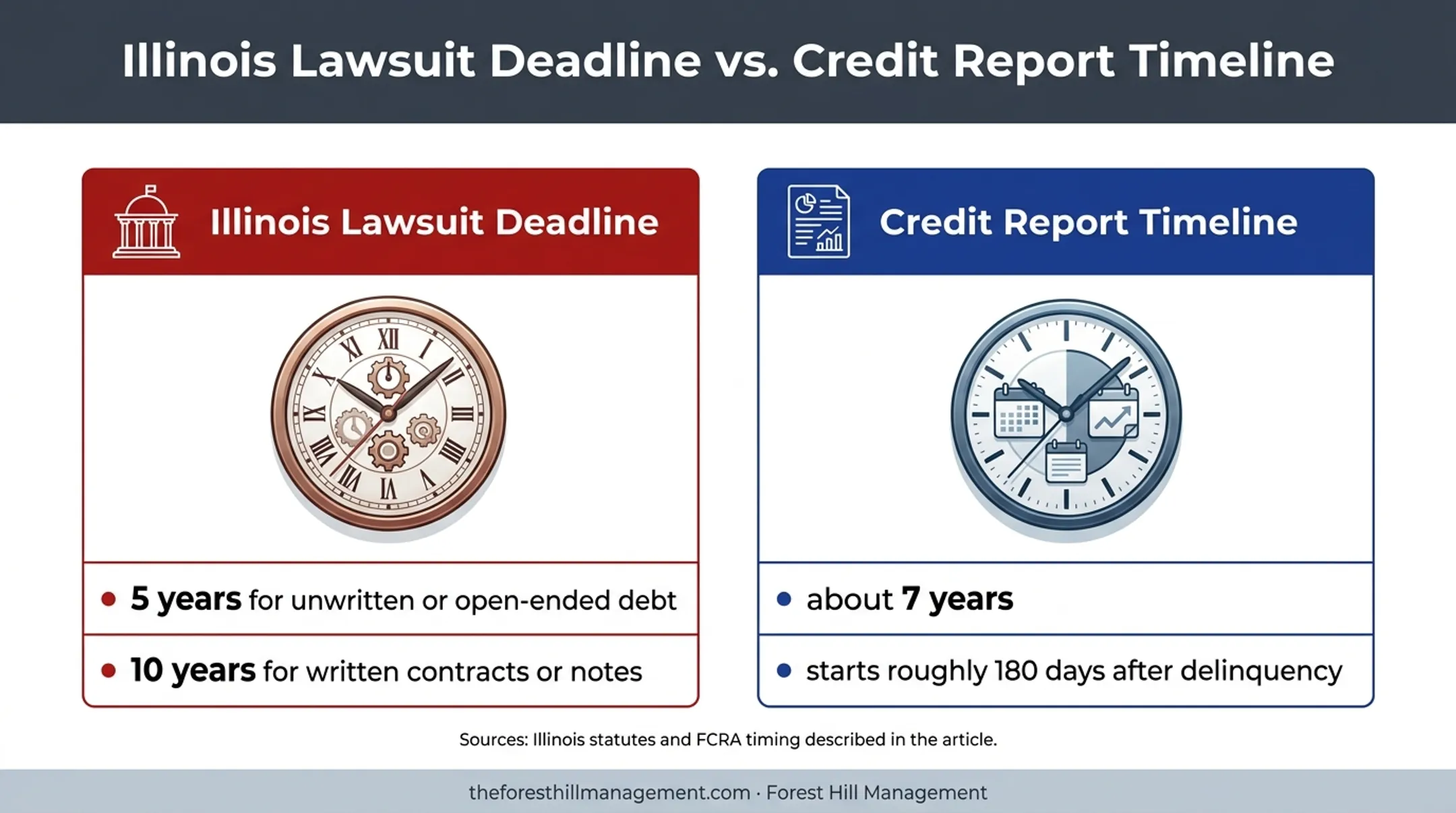
- Age off your credit report while remaining legally collectible
- Remain on your report while being time-barred for lawsuit purposes
These are two separate systems, and confusing them leads to costly assumptions.
Illinois Debt Collection Laws and Consumer Rights
Several laws work together to protect Illinois consumers from unfair collection practices:
- Fair Debt Collection Practices Act (FDCPA): federal law restricting third-party collector conduct, including harassment, threats, and deceptive statements about balances or legal status.
- Fair Credit Reporting Act (FCRA): governs how long and how accurately accounts appear on credit reports.
- Illinois Collection Agency Act: requires covered collection agencies operating in Illinois to be licensed.
- Illinois Consumer Fraud and Deceptive Business Practices Act: addresses broader unfair or deceptive conduct, according to the Illinois Attorney General's guidance.
Prohibited Collector Conduct
Collectors cannot:
- Harass you with repeated or threatening calls
- Threaten actions they can't legally take
- Misrepresent the balance or legal status of a debt
- Impersonate government officials or attorneys
- Disclose your debt to third parties improperly
- Mislead you about how the debt affects your credit
Validation Rights
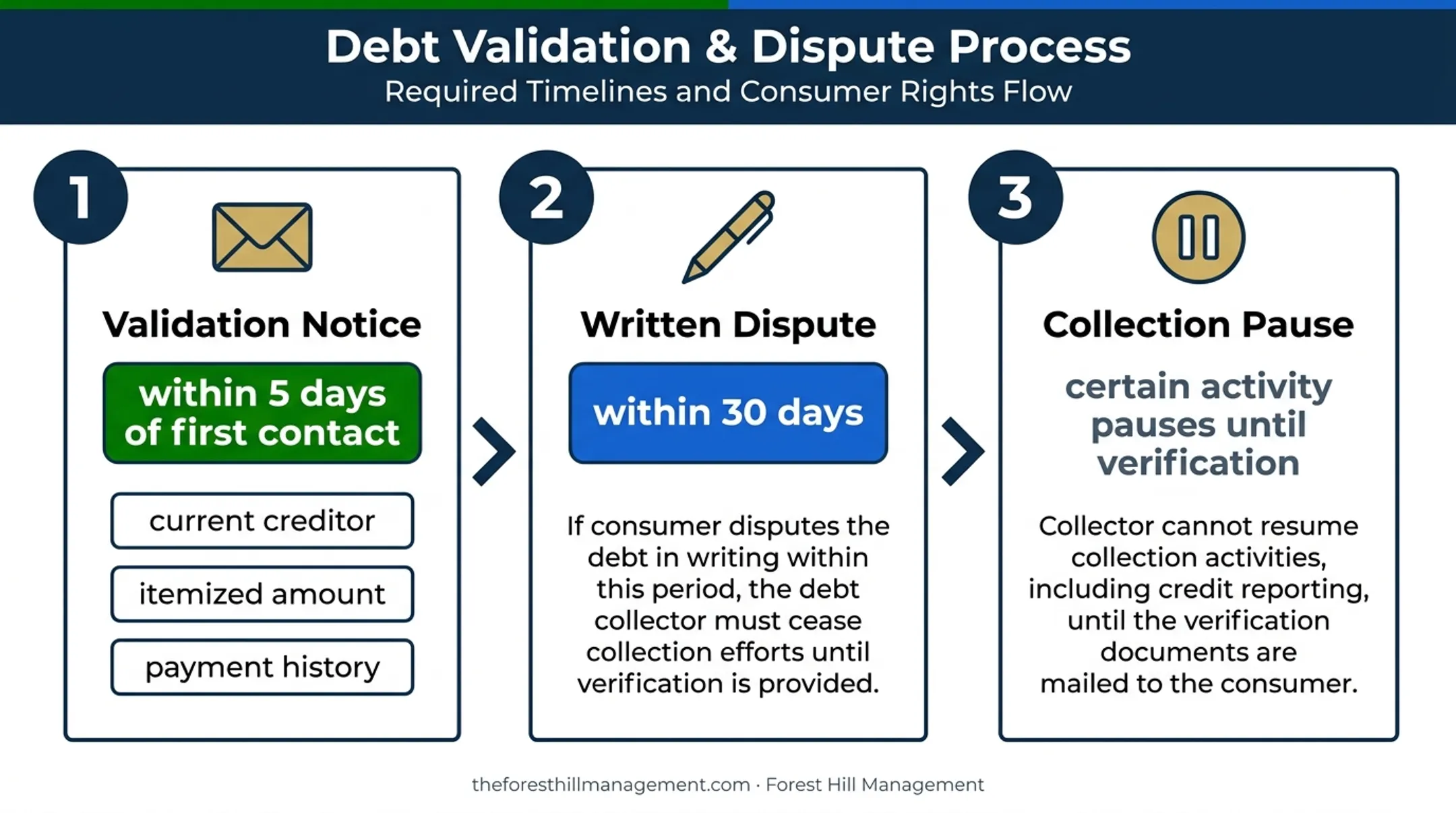
Under Regulation F, a collector generally must provide validation information within five days of first contact. That notice typically includes the current creditor's name, an itemized amount, and payment history. You then have 30 days to dispute the debt in writing. A timely dispute pauses certain collection activity until the collector verifies the debt.
Forest Hill Management services past-due consumer accounts nationwide and includes an "Original Creditor" section in its account correspondence so you can identify who you originally owed. If you've confirmed an account is valid and want to discuss resolution options, you can contact the company directly. Forest Hill Management is not a law firm and cannot determine your legal deadlines or provide legal advice.
Where to Get Help
- CFPB: file complaints about collection or reporting issues
- FTC: report scams through its consumer fraud portal
- Illinois Attorney General: consumer complaint page
- Local court clerk: case-specific procedural questions
- A consumer-rights attorney: for legal advice specific to your situation
What to Do If a Collector Contacts You or You Receive a Lawsuit
A collector call or lawsuit does not erase your options under Illinois law. Act quickly, document everything, and avoid steps that could restart the clock on an old debt.
Immediate Response Checklist
- Stay calm. Don't volunteer information or admit the debt is yours on a phone call.
- Request written validation. Get the creditor's name, balance, and itemization in writing.
- Verify the account. Cross-check any information against your own records.
- Review your payment history. This helps you spot-check the collector's claims.
- Communicate in writing when possible, and keep copies of everything you send.
Requesting validation or disputing inaccurate information is not the same as admitting you owe the debt. Use a trackable delivery method, such as certified mail, so you have proof of what you sent and when.
If You Receive a Summons
Read it immediately and note:
- The court name and case number
- The filing date and service date
- Your response deadline
Do not ignore court papers even if you believe the debt is time-barred. If you don't respond by the deadline, a court can enter judgment against you regardless of the debt's age.
When to Call an Attorney
Get legal help if:
- You dispute the debt or don't recognize it
- The account is old enough that limitations may apply
- You've been served with a lawsuit or a judgment already exists
- Bankruptcy is involved, or wages or bank funds are threatened
- The amount owed is significant
Mistakes to Avoid
- Relying on a collector's verbal statement about the deadline
- Assuming credit-report deletion means the debt expired
- Making a token payment before understanding the consequences
- Signing a settlement or acknowledgment without reading it carefully
Frequently Asked Questions
What is the statute of limitations on debt collection in Illinois?
It depends on classification: generally five years for unwritten or open-ended accounts and ten years for written contracts or promissory notes. This limits the time to file a lawsuit, not the time a collector can contact you or how long an account appears on your credit report.
What is the statute of limitations in Illinois for credit card debt?
Credit card debt is commonly treated as an open-ended account, putting it in the 5-year category, though a fully documented written agreement can shift it to 10 years. Check your account records and controlling Illinois law—or a consumer attorney—before relying on either period.
What are the laws regarding debt collection in Illinois?
The federal FDCPA, the FCRA, the Illinois Collection Agency Act, and the Illinois Consumer Fraud and Deceptive Business Practices Act all apply. Coverage and available remedies depend on the collector's conduct and the specific facts of your case.
What happens to unpaid collections after 7 years?
Roughly seven years after the triggering delinquency, a collection account typically stops appearing on your credit report under federal law. That's separate from Illinois's lawsuit deadline: a debt can age off your report while remaining legally collectible.
What is the new law in Illinois regarding credit cards?
Illinois's Interchange Fee Prohibition Act restricts certain fees charged to merchants on the tax or gratuity portion of card payments, with operative provisions scheduled for July 1, 2027. It doesn't change the state's debt-lawsuit deadlines under sections 13-205 or 13-206.