-p-500%20(1).png)
The Rosenthal Act: A Complete Guide to Fair Debt Collection
Need Help Reviewing Your Account?
Contact UsCalifornia's Rosenthal Fair Debt Collection Practices Act sets the ground rules for how debts get collected within state lines, while the federal Fair Debt Collection Practices Act (FDCPA) provides a nationwide floor of protections. Together, these two laws shape what a collector can and cannot say, when they can call, and what they must disclose.
A collection call, a letter demanding payment, or a new entry on your credit report can feel alarming. But collectors, whether they're original creditors or third-party agencies, have to follow specific rules around accuracy, privacy, contact methods, and the claims they make.
This guide covers who's protected under the Rosenthal Act, which debts and collectors fall within its scope, how it stacks up against the FDCPA, and what steps to take if you suspect a violation.
Disclaimer: This article provides general legal information, not legal advice. Laws change, and deadlines for filing claims are strict. Consult a qualified California attorney about your specific situation.
Key Takeaways
- The Rosenthal Act works alongside the federal FDCPA rather than replacing it.
- California's debt collector definition is broader and can include original creditors collecting their own accounts.
- Threats, harassment, deception, and improper third-party disclosures violate the Rosenthal Act.
- Keep notices and payment records, dispute inaccurate debts in writing, and never ignore a court summons.
What Is the Rosenthal Fair Debt Collection Practices Act?
The Rosenthal Fair Debt Collection Practices Act, codified at Cal. Civ. Code Section 1788 et seq., exists to stop unfair, deceptive, and privacy-invading conduct during debt collection. It also expects debtors to act in good faith when incurring and honoring their obligations.
How It Connects to the Federal FDCPA
For consumer debt, Section 1788.17 requires California collectors to comply with 15 U.S.C. Sections 1692b through 1692j, the core conduct rules of the federal FDCPA. Collectors are also subject to the FDCPA's remedy section. This incorporation locks in the federal language as it existed on January 1, 2001.
There's a notable carve-out. The federal disclosure and validation requirements in Sections 1692e(11) and 1692g don't apply to certain creditor employees and affiliates under 15 U.S.C. Section 1692a(6)(A) or (B). In practice, that means analyzing both statutes together, not picking one and ignoring the other.
Who Counts as a Debt Collector
California casts a wider net than federal law. A "debt collector" under Rosenthal is anyone who, in the ordinary course of business, regularly collects debts on their own behalf or for others, including sellers of collection forms or letters. That can include:
- Third-party collection agencies
- Debt buyers who purchased the account
- Attorneys engaged in collection activity
- Original creditors collecting their own accounts
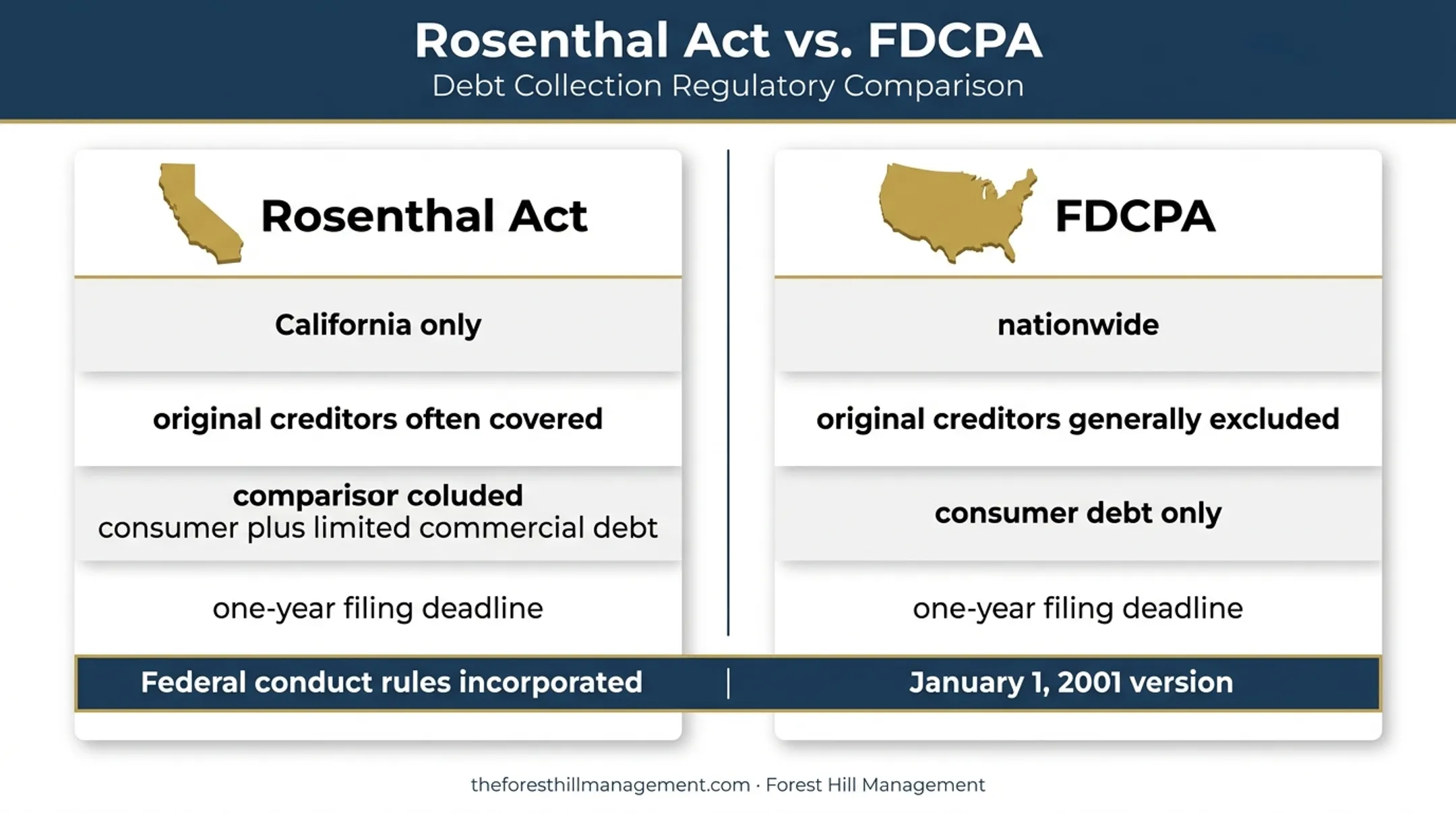
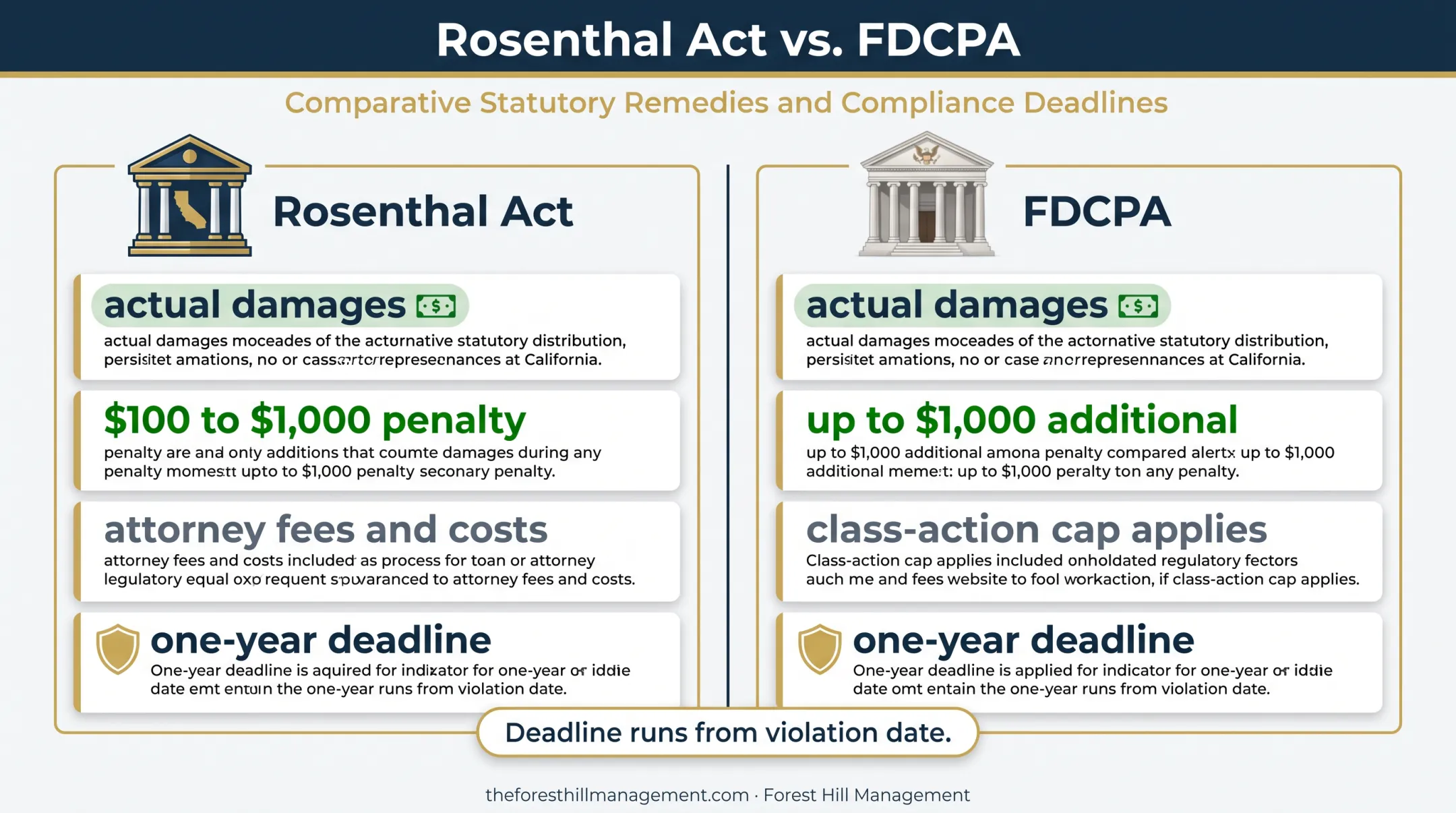
Here's how the two laws compare side by side:
The two laws differ in reach, but some limits apply to both. Neither lets a business waive these protections by contract. A violation also doesn't cancel an otherwise valid debt, so the balance may still be owed even if the collector broke the rules.
Which Debts and Debt Collectors Are Covered?
Rosenthal protections generally apply to consumer debt, meaning money owed by a natural person from a transaction primarily for personal, family, or household purposes.
Common Covered Debt Types
- Credit card balances
- Auto loans
- Medical bills
- Personal loans
- Mortgages and certain service-related debts
Coverage turns on what the debt was for, not who is collecting it. A credit card balance run up for groceries and gas counts as consumer debt whether an original creditor, a collection agency, or a debt buyer is chasing it.
The New Commercial-Debt Rules
California expanded coverage through SB 1286, extending select Rosenthal protections to "covered commercial debt." This applies to commercial credit transactions entered into, renewed, sold, or assigned on or after July 1, 2025.
Under the definition effective January 1, 2026, a covered commercial credit transaction:
- Has a value of no more than $500,000
- Is primarily for purposes other than personal, family, or household use
- Is owed by a natural person to a specified lender, financing provider, or debt buyer
- Counts toward that $500,000 cap when aggregated with other noncovered commercial transactions owed to the same entity
Certain trade credit and vehicle-dealer financing arrangements of at least $50,000 are excluded. That $50,000 figure is not a general minimum for Rosenthal coverage overall.
What Falls Outside the Rosenthal Act
These situations usually fall outside coverage:
- Occasional, non-regular private collection activity
- Debts unrelated to personal, family, or household purposes
- Certain business entity or guarantor obligations
A debt can fall outside FDCPA protection (because it's technically business-purpose or the collector qualifies for a federal exclusion) while still being covered under California's broader Rosenthal definitions.
This is a fast-moving area, so check current California authority before assuming a debt is excluded.
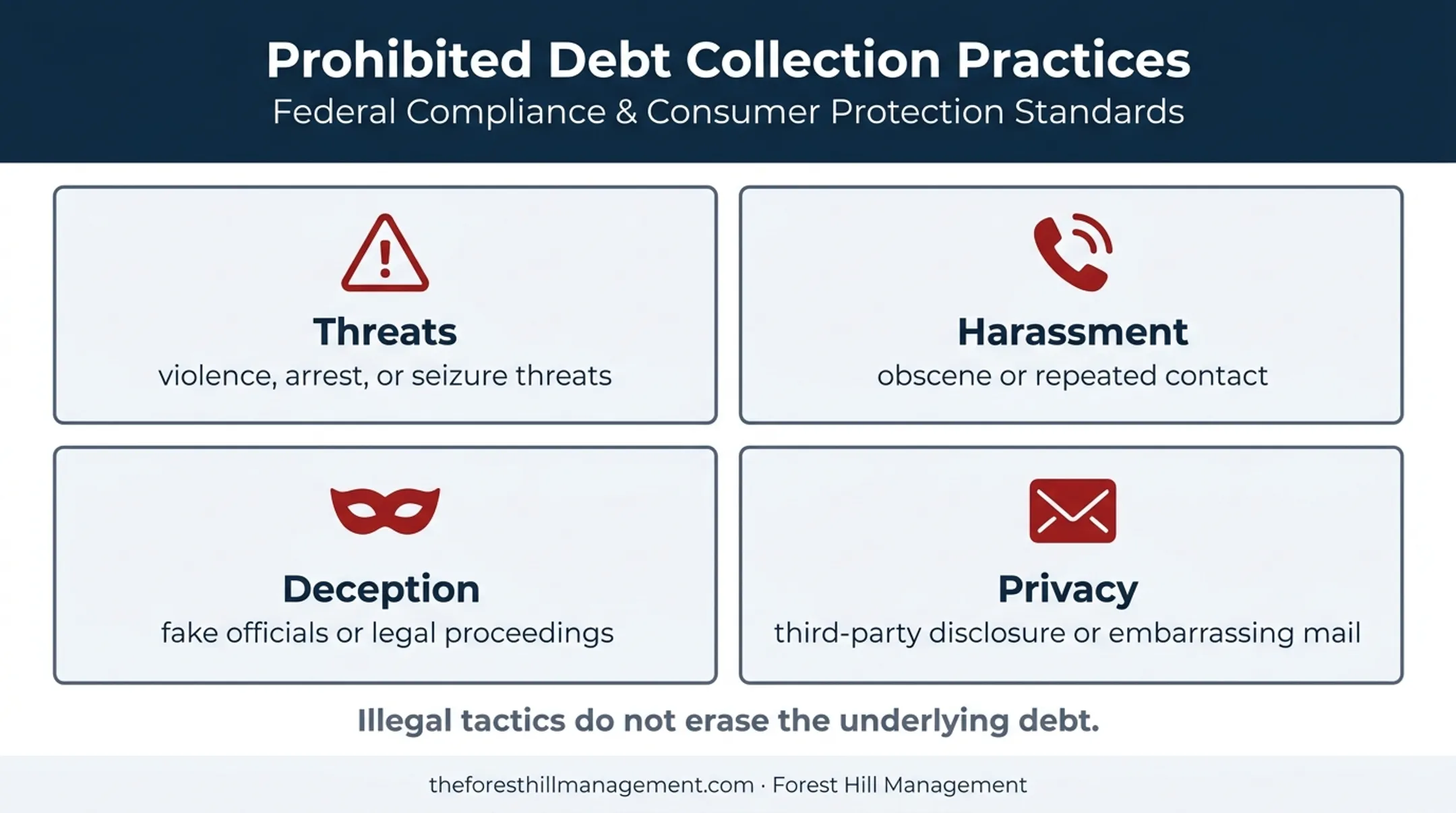
What Debt Collectors Cannot Do Under the Rosenthal Act
California law spells out prohibited conduct in detail, and it applies broadly, not just to collectors who also meet the federal FDCPA definition.
Threats and Intimidation
Under Section 1788.10, collectors cannot:
- Threaten violence or harm
- Falsely accuse someone of a crime
- Threaten arrest or seizure of property or wages unless that action is actually contemplated and lawful
- Threaten any act the Rosenthal Act itself prohibits
Harassment and Improper Contact
Section 1788.11 bars collectors from:
- Using obscene language
- Placing calls without identifying the caller
- Repeatedly ringing the phone to annoy someone
- Contacting you so often that it becomes harassment
A collector who calls dozens of times a day, refuses to say who they are, or keeps calling after learning you're represented by an attorney is stepping outside the law.
Deception and Simulated Legal Process
Section 1788.13 prohibits deceptive tactics such as:
- Falsely claiming to be an attorney or government official
- Misrepresenting fees that can be added
- Falsely suggesting legal proceedings have started
Section 1788.16 separately bans simulated court documents or fake legal notices designed to scare a debtor into paying.
Privacy Violations and Unauthorized Charges
Section 1788.12 limits third-party contact and public embarrassment tactics. Collectors cannot:
- Disclose the debt to your employer, relatives, or neighbors beyond what the statute allows
- Send postcards or use envelopes that reveal you owe money
- Use other communications meant to embarrass you about the debt
Section 1788.14(b) prohibits collecting the collector's own fees or expenses unless the law specifically permits it.
A collector violating these rules doesn't erase the debt. These are two separate legal questions: whether the collection tactics were illegal, and whether the underlying debt is still owed.
What to Do If You Believe a Collector Violated Your Rights
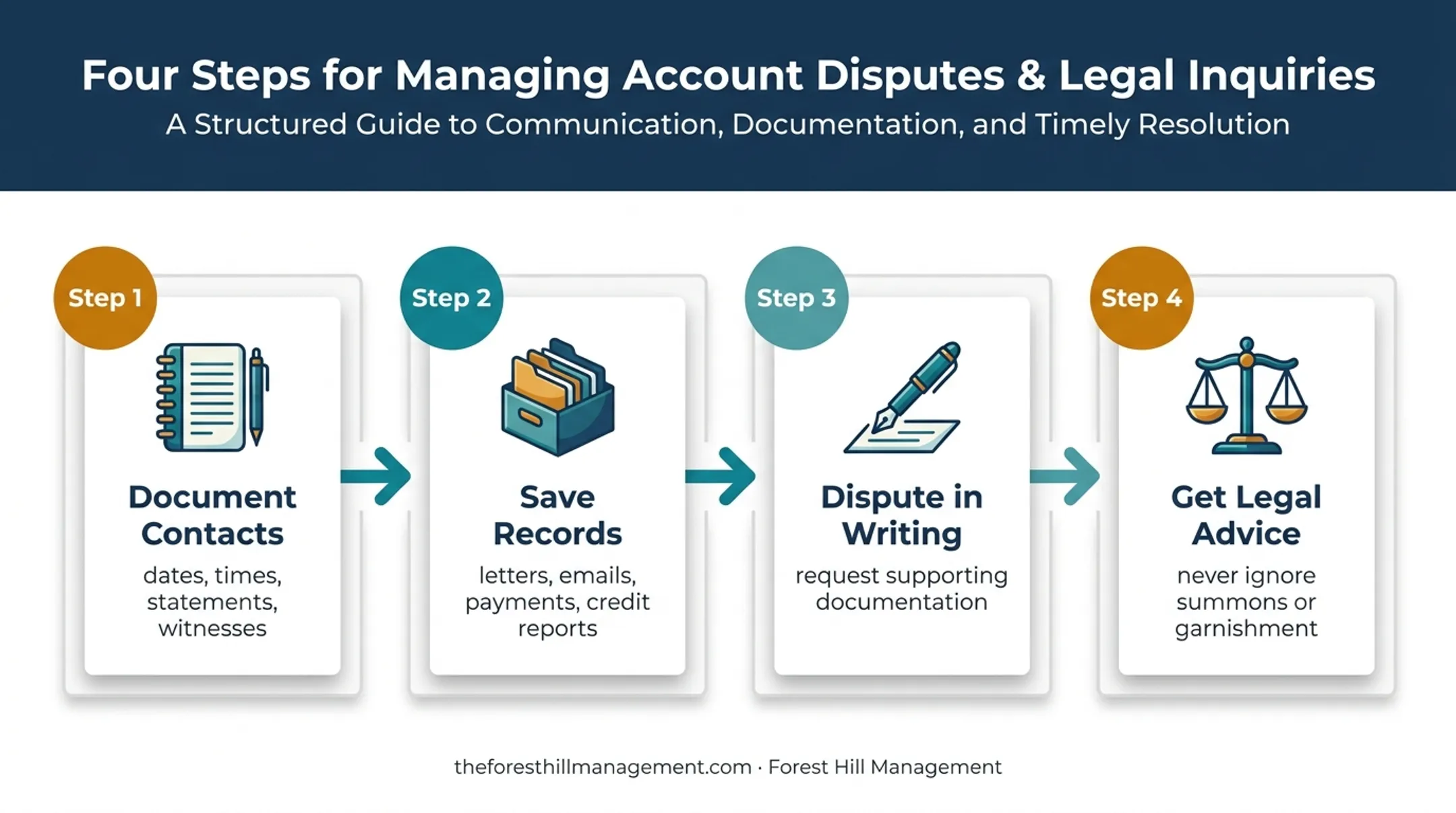
If a collector crosses a line, your response matters. Documentation and a clear paper trail are your strongest tools.
Build a Timeline and Save Everything
Start a written log with:
- Dates and times of contact
- Phone numbers and caller names
- Exact statements made
- Contact frequency
- Witnesses, if any
Keep every letter, envelope, email, text, voicemail, account statement, payment record, and credit report entry. Before recording any phone calls yourself, check California's consent laws first, since the state generally requires all parties to agree to being recorded.
Send a Written Dispute
A written dispute should ask for specifics:
- Original creditor's identity
- How the balance was calculated
- Interest and fees applied
- Last-payment date
- Chain of assignment
- Collector's authority (and license, where applicable) to collect
Debt validation requests typically operate on a 30-day window for the collector to respond.
Keep your dispute factual. Identify the inaccuracy, request supporting documentation, and avoid volunteering unnecessary personal details or anything that could read as an admission.
Set Communication Boundaries
You can request:
- Written-only communication going forward
- That the collector deal only with your attorney
- A cease-contact request, where legally applicable
Keep in mind that limiting contact doesn't stop a lawsuit or eliminate the debt itself; it only changes how the collector can reach you.
If you're working directly with a receivables management company to resolve an account, you're entitled to ask clear questions. Confirm who owns the debt now, what resolution options exist, and get written confirmation of any payment arrangement before you send money.
Forest Hill Management, for instance, works with consumers to clarify account details and document agreed-upon terms in writing. It is not a law firm and can't guarantee a specific legal outcome.
Never ignore a summons, complaint, or garnishment notice. If litigation is filed or threatened, get legal advice immediately. Deadlines to respond are short, and missing them can result in a default judgment.
Enforcement, Complaints, and Potential Remedies
When a collector breaks the Rosenthal Act, you can complain to regulators, sue for damages, or both. Agency complaints create a record; a private claim is how you recover money. Collectors also get a short window to fix some errors before liability sticks.
Where to File a Complaint
Several agencies take debt collection complaints. Filing with them is separate from a private lawsuit:
- California Attorney General – consumer complaint form against a business
- Department of Financial Protection and Innovation (DFPI) – debt collector and unlicensed-activity complaints, 866-275-2677
- Consumer Financial Protection Bureau (CFPB) – online complaint portal or 855-411-2372
- Federal Trade Commission (FTC) – reportfraud.ftc.gov for fraud and scam reports
Damages You May Recover
Under Cal. Civ. Code Section 1788.30, you can pursue actual damages from a violation. If the violation was willful and knowing, courts may add a penalty between $100 and $1,000. A prevailing debtor also recovers reasonable attorney's fees and costs.
Federal law under 15 U.S.C. Section 1692k allows similar actual damages plus up to $1,000 more on individual claims, with a separate cap for class actions.
State and federal private-action deadlines both run one year from the date of the violation. Don't wait to talk with an attorney.
To recover, you generally need proof such as:
- Written correspondence with the collector
- Call logs or phone records
- Witness statements about contacts or threats
- Payment history on the account
- Credit report entries that show harm
The Cure Provision
California gives collectors a narrow escape hatch. Under Section 1788.30(d), a collector isn't liable for a curable violation if, within 15 days of discovering it or receiving written notice, they notify the debtor and make the correction.
That is not a blanket pass. The collector still must show the error was unintentional and that it kept reasonable procedures to prevent it.
A documented violation can improve your settlement leverage. It does not let you skip legally required payments or misstate facts for an edge.
If you face repeated harassment, a pending lawsuit, wage garnishment, identity theft, or serious credit damage, contact a consumer-rights attorney.
Frequently Asked Questions
What is the Rosenthal Fair Debt Collection Practices Act?
It's California's state law regulating debt collection conduct, working alongside the federal FDCPA rather than replacing it. It governs how collectors behave, but it doesn't automatically cancel a valid debt.
Can you dispute a debt if it was sold to a collection agency?
Yes. You can dispute an inaccurate or unsupported debt and request documentation regardless of who currently owns it. Selling or assigning a debt doesn't by itself make it invalid.
How long before a debt becomes uncollectible in California?
In California, the lawsuit deadline is generally two to four years, depending on the contract type. That limit is separate from a collector's ability to request voluntary payment or report the debt. Check the CFPB's guidance and confirm your debt type and last payment date.
Who qualifies as a debt collector under the FDCPA?
Federal law generally targets people or companies collecting debts owed to someone else, often excluding original creditors. The Rosenthal Act casts a wider net that can include original creditors collecting their own accounts.
What type of debt is not covered by the FDCPA?
Business-purpose debts generally fall outside FDCPA protection, along with some collection activity by original creditors acting under their own name. Rosenthal Act coverage should be assessed separately since California's rules are broader.
Do I have to pay my debt if it was sold to a debt collector?
Selling or assigning a debt doesn't eliminate a valid obligation. If details look wrong, request written verification of the debt and the collector's authority before you pay.