-p-500%20(1).png)
Does Paying Collections Improve Your Credit Score?

Need Help Reviewing Your Account?
Contact UsPaying off a collection account might raise your credit score. It might not move the needle at all. The honest answer depends on which scoring model a lender pulls, how old the debt is, and what else is sitting in your credit file.
Payment history makes up 35% of your FICO Score, so it's tempting to assume clearing a collection will produce a quick bump. But collections don't work like a light switch. Some scoring models ignore paid collections entirely. Others still count them, paid or not. And even when a model rewards payment, the update to your credit report can take weeks to show up.
This guide walks through how collections actually affect your score, when payment helps, and what to do before and after you send money to a collector.
Key Takeaways
- Paid collections may help on FICO 9/10 and VantageScore 3.0/4.0—not usually on FICO 8.
- Payment status updates typically take one to two months to appear on your credit report.
- A paid collection can still stay on your report for up to seven years from the original delinquency.
- Verify the debt and check your state's statute of limitations before paying anything.
How Collections Affect Your Credit
A collection account starts as a missed payment. Creditors generally don't report a late payment until it's 30 days past due. If it stays unpaid, the original creditor may write it off internally as a charge-off, then sell or assign it to a collection agency.
Each stage can show up differently on your report:
- Late payment — a single missed due date on an existing account.
- Charge-off — the original creditor's internal write-off of the debt as a loss.
- Collection account — a new entry created once the debt moves to an internal collections unit or third-party agency.
All three can appear on your credit report separately, even though they stem from the same unpaid bill.
The Reporting Clock Doesn't Reset
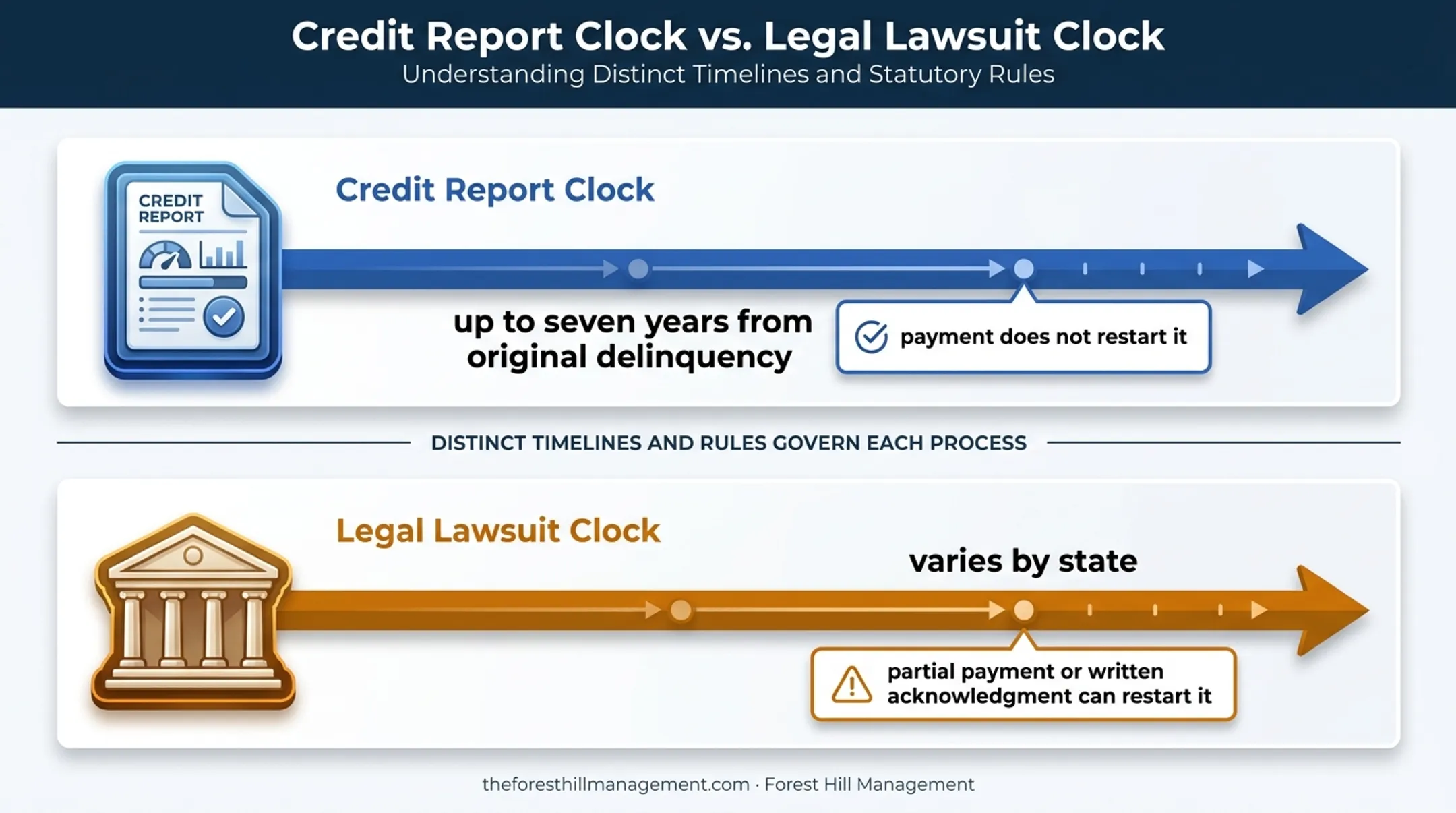
Here's where a lot of people get tripped up. A nonmedical collection can stay on your credit report for up to seven years from the date of the original delinquency. That clock does not restart when a collection agency acquires the account, and it does not restart when you pay.
Experian's guidance on collection reporting periods confirms that paying the balance doesn't restart or extend that seven-year window.
Medical Debt Gets Different Treatment
Medical collections follow separate bureau rules:
- Paid medical collections removed from reports as of July 1, 2022
- Unpaid medical debt waiting period extended from six months to one year
- Medical collections under $500 removed starting in 2023
Equifax, Experian, and TransUnion put those exclusions in place. A broader CFPB rule on medical debt reporting was finalized in January 2025, then vacated by a federal court on July 11, 2025. That court action is separate from the bureau-level exclusions above, which remain in place.
A credit report entry and a credit score are two different things. The same collection can be visible on your report while being completely ignored by one scoring formula and penalized by another. That distinction drives everything in the next section.
Does Paying a Collection Improve Your Credit Score?
Short answer: it depends entirely on the scoring model.
FICO vs. VantageScore Treatment
According to myFICO's explanation of how collections affect credit scores, paying a collection can raise, lower, or leave a score unchanged, depending on which scoring version is pulled and what else is on your file.
FICO Score 8 remains one of the most widely used base versions, but many mortgage lenders still pull older versions like FICO 2, 4, or 5. Auto lenders often use FICO Auto Scores, while card issuers frequently rely on FICO Bankcard Scores or Score 8/9.
There is no single "the score." Dozens of versions exist, and they do not all treat a paid collection the same way.
Status Labels Aren't Interchangeable
Lenders and scoring models read these terms differently:
- Paid in full — the original balance was paid as agreed.
- Settled — you and the collector agreed to a lower amount than owed.
- Zero balance — no money is currently due, which newer FICO versions treat similarly to "paid."
- Deleted — the account no longer appears on your report at all.
- Updated — the report reflects new information, but the account is still present.
Paying a valid, accurately reported collection typically changes its status. It does not erase the entry. Deletion generally only happens when information is inaccurate, duplicated, incomplete, or unverifiable—a dispute situation, not a payment situation.
Timing: Three Separate Clocks
Don't expect an overnight change. There are three distinct steps between payment and any score movement:
- Collector updates its internal records after receiving your payment.
- Collector reports the change to the bureaus: Experian estimates this typically takes one to two months.
- Bureaus process the update and your score recalculates the next time it's pulled.
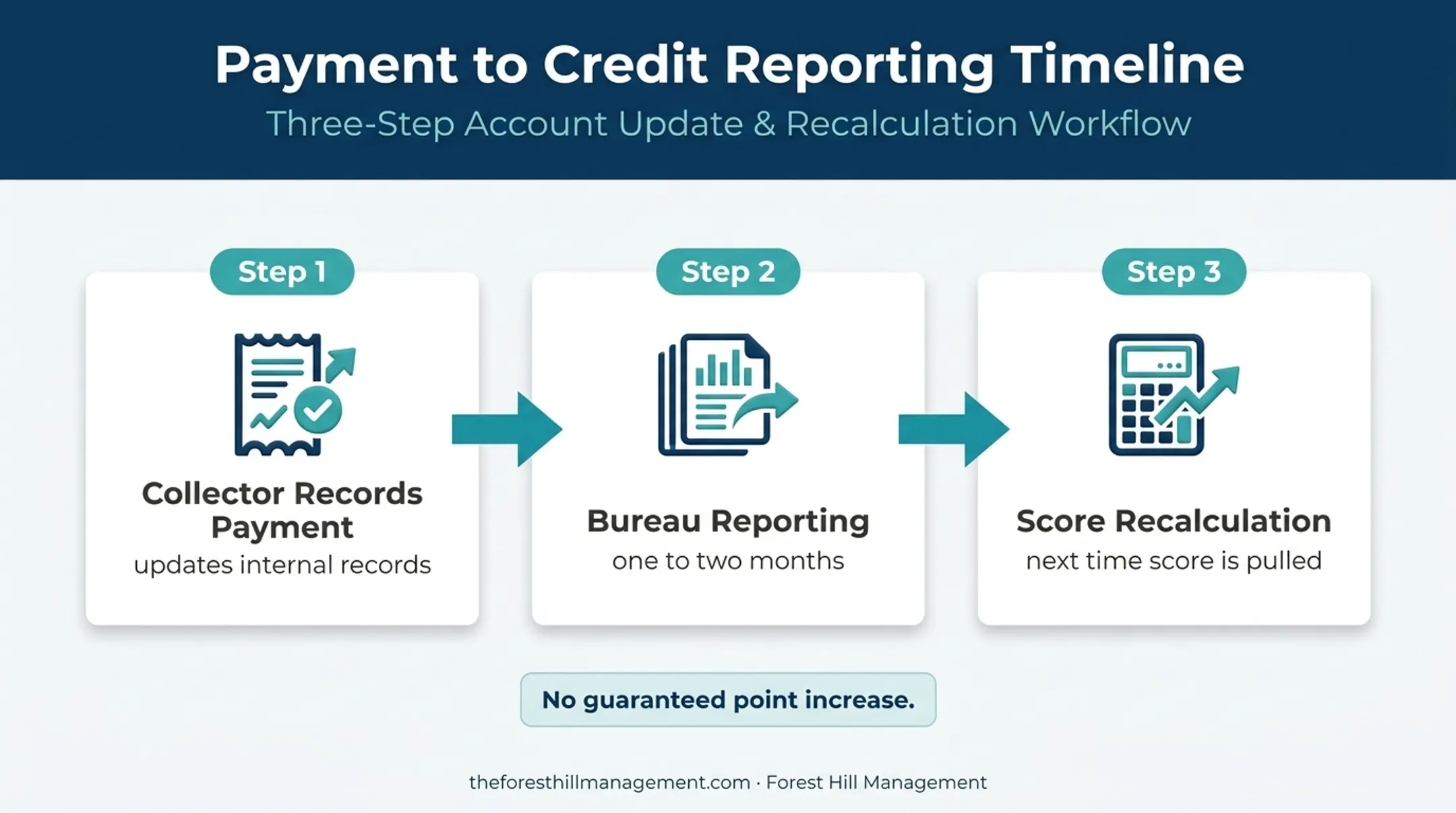
No part of that sequence is instant, and none of it guarantees a specific point increase.
Should You Pay a Collection Account?
Even without a guaranteed score bump, paying a collection can still be worth doing. It resolves the underlying obligation and can reduce ongoing collection calls. Some lenders also manually review paid versus unpaid collections, which may help your application even when the score itself barely moves.
Verify Before You Pay
Never pay a collection blind. Before sending any money:
- Confirm the collector's identity and that the debt is legitimate.
- Request written validation, including the original creditor's name and the amount owed.
- Compare the amount against your own records and current credit reports.
- Check for duplicate listings of the same debt under different names.
If Forest Hill Management contacted you about an account, call (888) 471-0109 or email info@foresthillmanagement.com to review the details or discuss resolution options. Always get any settlement or payment agreement in writing before you pay.
Compare Your Options
No single option is best for every situation. Paying in full, settling, and payment plans each affect your balance and reported status differently:
- Paying in full clears the balance and, under newer scoring models, may help how the account is scored.
- Settling for less resolves the debt but leaves a "settled" notation rather than "paid in full."
- Payment plans spread the cost but may keep the account reporting as open until fully satisfied.
Protect Your Budget First
Don't pay an old collection at the expense of rent, utilities, food, insurance, or your current account payments. Review your complete budget before committing to any arrangement, and don't drain emergency savings to settle a years-old debt.
Check the Statute of Limitations
Before paying or even acknowledging an old debt, research your state's statute of limitations on debt collection lawsuits. In many states, a partial payment or written acknowledgment can restart that legal clock, even on a debt that was already time-barred.
That legal timeline is separate from how long the debt stays on your credit report. Rules vary by state, so confirm your specific situation before acting.
What to Do After Paying a Collection
Once you've paid or settled, your job isn't finished. Documentation and follow-up protect you if something goes wrong.
Keep everything:
- Payment receipts and confirmation emails
- Settlement letters and account numbers
- Any written promise about how the account will be reported
If you paid through Forest Hill Management, request written confirmation of the settled or paid-off account. Submit your name and account number through the company's email form. Confirmation goes to the email or mailing address on file.
Check Your Reports
After allowing reasonable processing time — typically one to two months — pull your reports from Equifax, Experian, and TransUnion. Look for:
- Correct balance and account status
- Accurate account ownership
- No duplicate listings of the same debt
If the Update Doesn't Appear
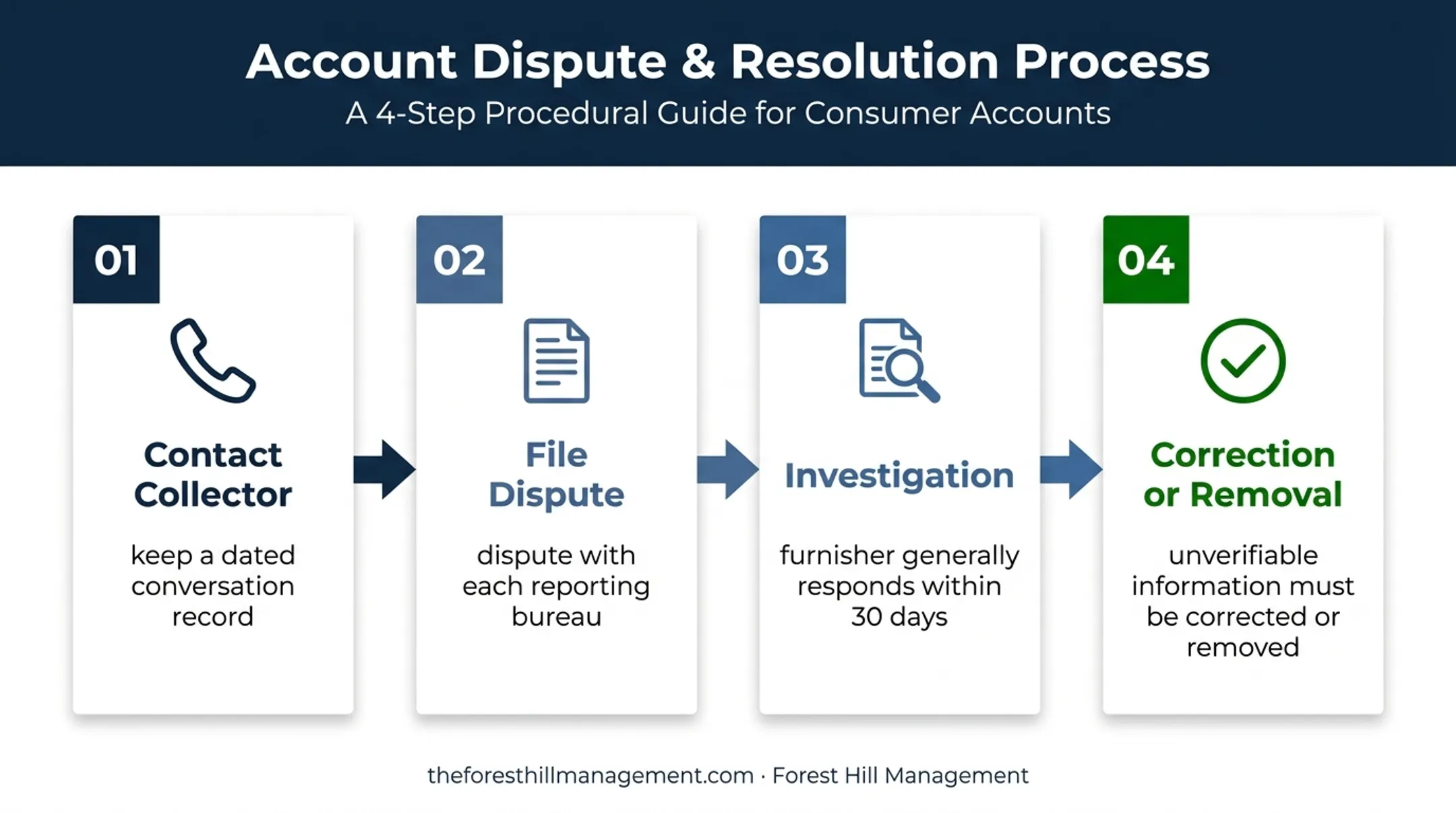
Contact the collector first and keep a dated record of that conversation. If the report still shows inaccurate information, file a dispute with each bureau reporting the error.
Under CFPB guidance on disputing credit report errors, furnishers generally must investigate and respond within 30 days. Information that can't be verified must be corrected or removed.
A paid collection may still legally remain on your report for the applicable reporting period unless it's inaccurate or covered by a specific removal arrangement. A status update also doesn't guarantee a score increase. Check the specific score your lender will use whenever possible.
Rebuilding Credit After Collections
Resolving a collection is one step. Building a stronger credit profile afterward matters just as much.
- Stop new late payments — use due-date reminders or autopay where they fit your budget, and keep every current account on time.
- Lower revolving utilization — paying down credit card balances complements collection resolution, but avoid taking on new debt you can't afford.
- Limit new applications — fewer hard inquiries while you're stabilizing finances helps, especially before a major loan application.
- Review all three credit reports — check regularly for inaccurate information, identity theft, or duplicate accounts.
Secured cards, credit-builder loans, and nonprofit credit counseling can be useful optional tools. Before you sign up, compare fees, confirm the product reports to all three bureaus, and verify the provider's legitimacy.
Bottom Line
Paying a collection is often the right financial move, but the credit-score outcome depends on the scoring model, the account's age and type, how the update gets reported, and your broader credit profile. There's no universal number of points to expect.
The safest sequence:
- Verify the debt
- Get the terms in writing
- Protect essential bills first
- Pay with a traceable method if it makes sense
- Confirm the reporting update afterward
Resolving past-due obligations and building consistent payment habits still puts you back in control of your finances, even when no score bump or timeline is guaranteed.
Frequently Asked Questions
How fast will my credit score go up if I pay off all my collections?
There's no fixed timeline or guaranteed point increase. It depends on the scoring model used, the collection's details, how quickly the update is reported, and everything else in your credit file.
How soon after you pay a collection will it be removed?
Payment updates the account's status ; it doesn't automatically delete it. Accurately reported collections can remain for up to seven years unless a valid removal exception applies.
What should I do after paying off a collection?
Keep your payment documentation, check your reports from all three bureaus after a month or two, confirm the balance and status are accurate, and dispute any errors you find.
Does paying off something in collections improve credit score?
It may help under models like FICO 9, FICO 10, and VantageScore 3.0/4.0, which disregard paid collections. Older models like FICO 8 can still count a paid collection against you.
Is it better to pay off a collection or have it removed?
Removal generally isn't available for accurate information . Disputes are meant for errors, not for otherwise valid debts. Only pursue deletion terms that are legitimately offered and documented in writing.
Is it better to pay off collections or credit cards first?
It depends on current-payment risk, legal considerations, interest costs, utilization, account age, and available cash. Whichever you prioritize, keep making required payments on all your accounts.