-p-500%20(1).png)
Fair Debt Collection Practices Act: Complete Guide
Need Help Reviewing Your Account?
Contact UsGetting a call about an unpaid bill is stressful enough. Getting three calls a day, a letter that threatens arrest, or a voicemail from someone claiming to be a lawyer when they're not? That crosses into territory federal law was written to stop.
The Fair Debt Collection Practices Act (FDCPA) is a federal consumer-protection law that limits abusive, deceptive, and unfair conduct by many third-party debt collectors. It doesn't erase debts. It draws boundaries around how covered collectors can pursue them.
This guide covers who the FDCPA applies to, what collectors can and can't do, how debt validation works, and what steps to take if you believe your rights were violated. It's general information, not legal advice.
Key Takeaways
- The FDCPA covers third-party collectors of personal debts, not original creditors or business debts.
- Core rules limit contact, require debt validation, and ban harassment, deception, and unfair fees.
- Preserve evidence and review validation notices; never ignore a collection letter or lawsuit.
- Federal and state consumer laws often overlap, so your remedy depends on your facts and jurisdiction.
Who and What Does the FDCPA Cover?
Congress passed the FDCPA to stop abusive, deceptive, and unfair tactics used to collect consumer debt, meaning debt from personal, family, or household purposes, according to 15 U.S.C. § 1692a. Business debt falls outside this definition entirely.
Who Counts as a "Debt Collector"?
The law defines a debt collector as a person or company whose principal business is collecting debts, or who regularly collects debts owed to someone else. That includes:
- Third-party collection agencies
- Debt buyers who purchase delinquent accounts
- Attorneys who regularly collect debts for clients
Original creditors collecting their own accounts are usually excluded — with one notable exception. If a creditor collects under a name that suggests a separate collection company is involved, it can be treated as a debt collector under the statute.
What This Coverage Doesn't Tell You
FDCPA coverage is about conduct, not validity. Whether a debt is accurate, whether you actually owe it, and whether the statute of limitations has expired are separate questions entirely.
Other laws fill those gaps. Regulation F (the CFPB's rule implementing the FDCPA), the Fair Credit Reporting Act, and state debt-collection laws often add further protections. Rules change, so verify current requirements through the CFPB or FTC.
What Rights Does the FDCPA Give Consumers?
Federal law limits when, how, and how often a collector can contact you. Those protections cover call timing, workplace contact, third-party privacy, required disclosures, debt validation, and your right to stop communication.
Contact Timing and Location
Calls before 8 a.m. or after 9 p.m. in your local time zone are presumed inconvenient unless the collector has reason to know otherwise. Collectors also can't call your workplace if they know your employer prohibits it.
The Seven-in-Seven Rule
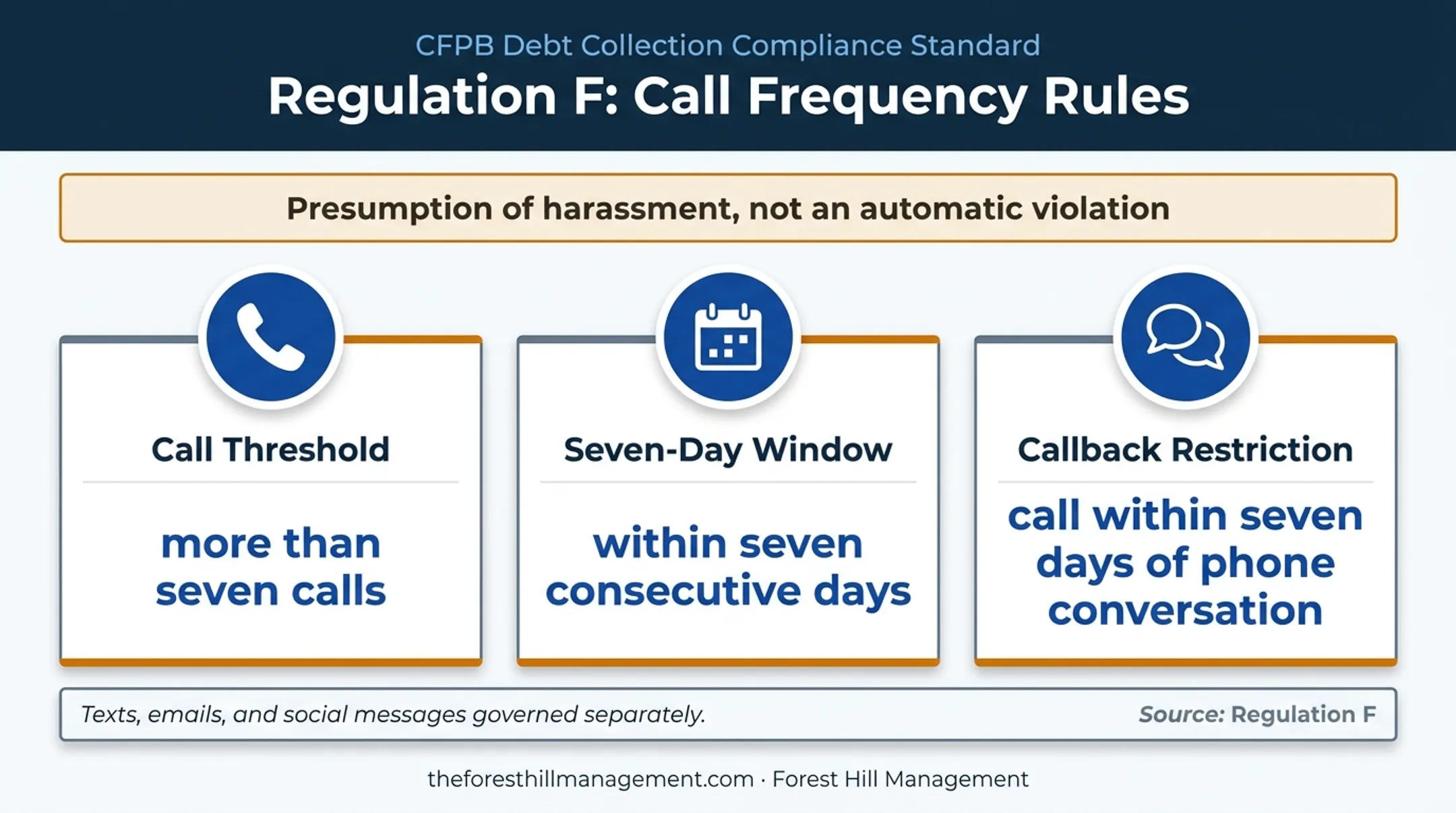
Under Regulation F, placing more than seven calls about one debt within seven consecutive days creates a rebuttable presumption of harassment. So does calling again within seven days of an actual phone conversation about that debt.
Keep these points in mind:
- This is a presumption, not an automatic violation — collectors can potentially rebut it with evidence.
- Seven or fewer calls doesn't give a collector a free pass to harass you.
- The rule applies to phone calls specifically; texts, emails, and social-media messages are governed separately.
Third-Party Contact Restrictions
Collectors generally cannot tell your relatives, neighbors, employer, or friends about your debt. They may contact a third party only to locate you, and only under these limits:
- They can only ask for your location information, once, in most cases.
- They cannot say you owe a debt.
- They can only name their employer if directly asked.
The "Mini-Miranda" Disclosure
On first contact, a collector must state that it's attempting to collect a debt and that any information obtained will be used for that purpose. Forest Hill Management's own text notices reflect this exact requirement: "This is an attempt to collect a debt. Any information obtained will be used for that purpose."
Debt Validation Notices
Collectors must typically send a validation notice within five days of first contact. Under Regulation F, that notice should include:
- The current creditor's name
- The itemized amount owed, including fees and payments since a stated date
- Your right to dispute the debt in writing
- Your right to request the original creditor's name and address
You have 30 days from receipt to dispute the debt in writing. A timely dispute pauses collection activity until the collector verifies the debt, per 15 U.S.C. § 1692g. Not disputing a debt is not an admission that you owe it.
Stopping Contact
Validation and dispute rights are separate from your right to cut off collector outreach. You can send a written request telling a collector to stop contacting you. That usually ends further communication, except for narrow notices such as specific legal remedies.
Important: A stop-contact request does not cancel the debt, and it does not necessarily prevent a lawsuit. For digital channels, Regulation F requires a simple opt-out method for each email address or phone number. Forest Hill Management's SMS policy, for example, lets recipients text "STOP" to opt out and receive confirmation.
What Are Common FDCPA Violations?
CFPB complaint data shows where collectors most often cross the line.
Harassment and Abuse
Harassment covers several prohibited tactics:
- Threats of violence or harm
- Obscene or abusive language
- Repeated contact meant to annoy
- Publicizing a debt to embarrass someone
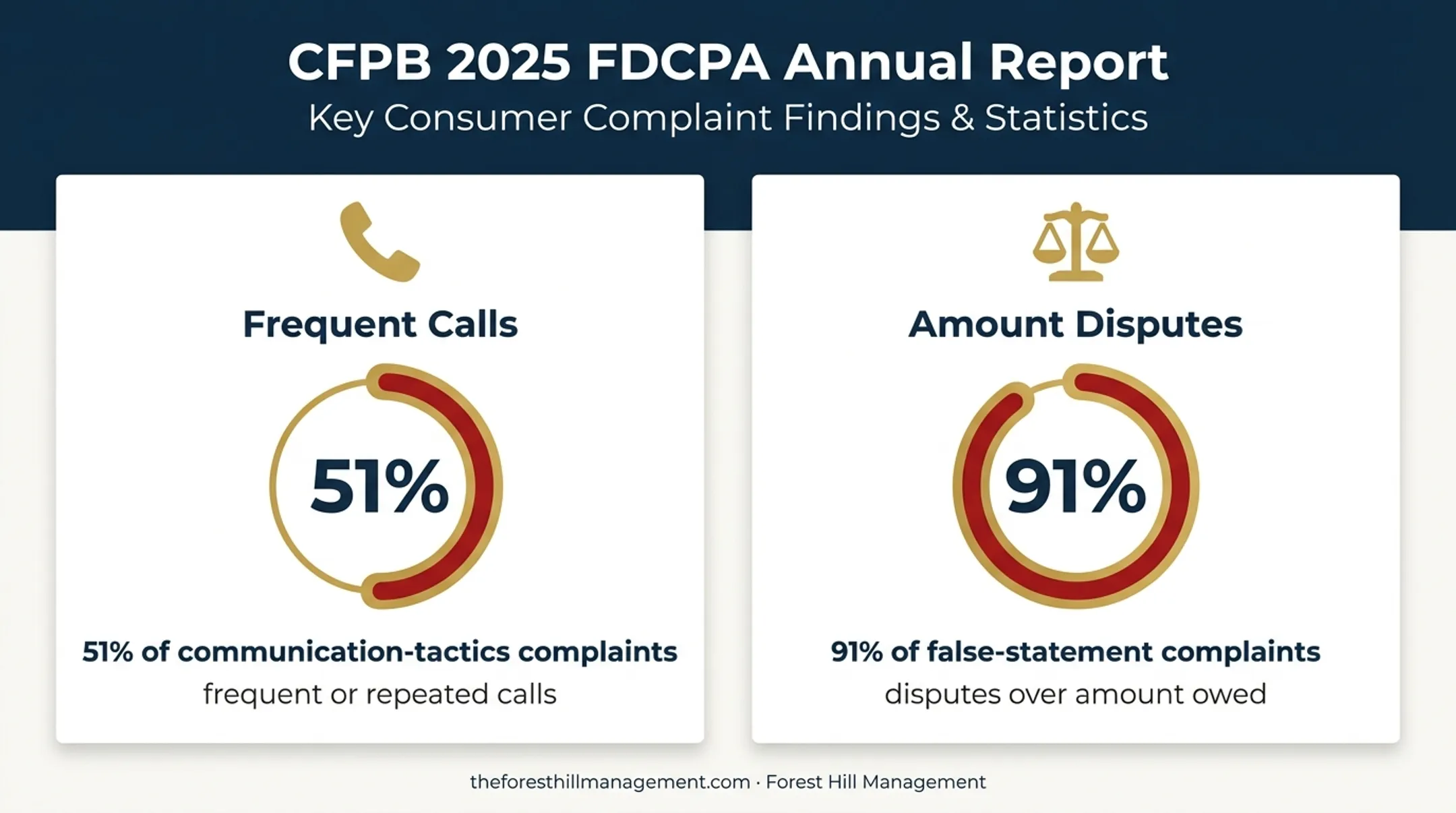
In the CFPB's 2025 annual report, 51% of communication-tactics complaints described frequent or repeated calls, and 34% described continued contact after a stop request.
False or Misleading Statements
Some of the most serious violations involve deception:
- Misrepresenting the amount owed
- Pretending to be an attorney or government official
- Falsely threatening arrest
- Threatening legal action the collector has no intention of taking
According to the CFPB's 2025 FDCPA Annual Report, 91% of false-statement complaints involved disputes over the amount owed, which shows how often balance errors drive these cases.
Improper Disclosures and Communications
Collectors also violate the FDCPA when they mishandle who sees the debt and how they identify themselves:
- Revealing a debt to unauthorized third parties
- Posting about a debt publicly on social media
- Sending envelopes that reveal the nature of the letter
- Failing to identify as a debt collector or provide an opt-out method
Unfair Collection Practices
The Act also bans practices that create unfair pressure to pay:
- Adding unauthorized interest or fees
- Depositing a post-dated check early
- Misapplying payments to the wrong account or balance
- Using deceptive means to extract payment
When the Debt Itself Is the Problem
Sometimes the problem starts with the debt itself. Identity mix-ups, debts past the statute of limitations, and failure to investigate a timely dispute can each raise separate concerns. Whether any of this is a violation depends on your facts and applicable state law—use this as a starting point for questions, not a final answer.
What Should You Do If a Debt Collector Violates the FDCPA?
If something feels off, here's a practical sequence to follow.
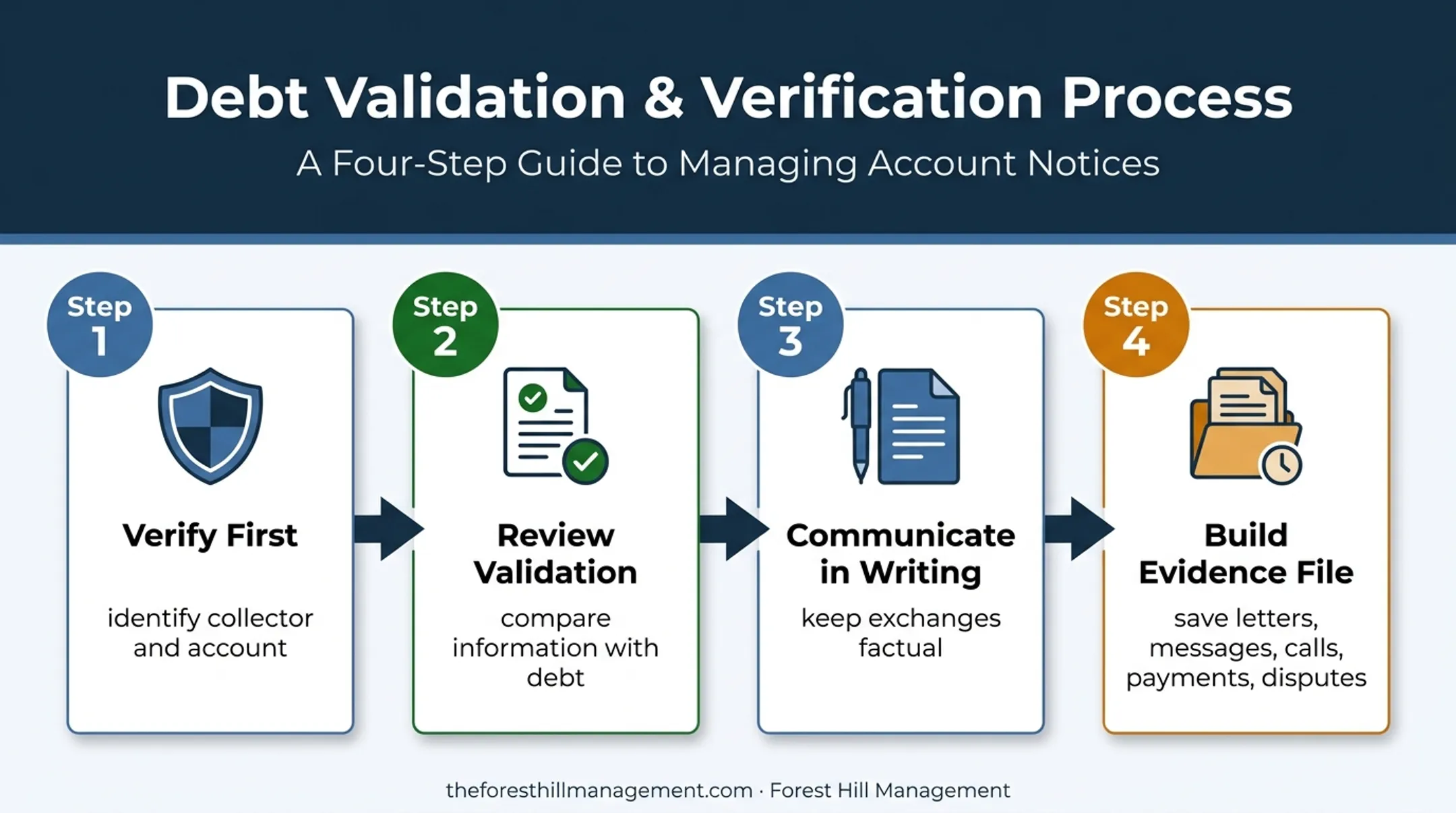
- Stay calm and verify first. Don't confirm or admit to an unverified debt. Ask the collector to identify themselves and the account.
- Request or review validation information. Compare it against what you actually owe.
- Keep communications factual and in writing when possible. Avoid emotional exchanges that could be used against you later.
- Build an evidence file. Save everything:
- Letters and envelopes
- Emails, texts, and social-media screenshots
- Voicemails and call logs (dates, times, caller names)
- Payment records and copies of any written disputes
Reporting and Legal Options
You have several avenues if a violation appears to have occurred:
- File a complaint with the Consumer Financial Protection Bureau or call 855-411-2372.
- Report to the FTC or your state attorney general.
- Consult a qualified consumer-protection attorney about a potential private claim.
Under 15 U.S.C. § 1692k, consumers generally have one year from the date of the violation to file suit. Remedies can include actual damages, additional damages up to $1,000 the court may allow, and attorney's fees in a successful case. Outcomes depend entirely on the facts, and no result is guaranteed.
Filing a regulatory complaint is not the same as filing a lawsuit. Don't let the one-year window slip by while you pursue other channels.
If the Debt Turns Out to Be Legitimate
Not every collection contact is a violation. Sometimes, once you've verified the account is accurate and belongs to you, the more productive path is resolution rather than dispute.
Forest Hill Management is a receivables management organization that services past-due accounts transferred from original creditors. It works with consumers on documented, respectful repayment options, including flexible payment plans and online account access.
Reaching out does not replace your legal rights or your ability to dispute an account. It is simply one option once you've confirmed a debt is yours to resolve.
Conclusion
The FDCPA doesn't make debts disappear. It sets rules for how covered collectors can communicate and what they can and can't say while pursuing payment.
If you're dealing with a collector right now:
- Verify the account before you pay
- Keep detailed records of every contact
- Respond to validation notices within the 30-day window
- Get professional guidance if you face threats, identity theft, a lawsuit, or a possible statutory violation
Frequently Asked Questions
What are fair debt collection practices?
Collectors must identify themselves, give accurate debt information, honor validation rights, and avoid harassment or deception. Those duties define lawful, non-abusive collection under the FDCPA.
What is the most common violation of the FDCPA?
CFPB complaints most often involve debts people say they don't owe, weak validation details, and harassment. Whether conduct is a legal violation still depends on the facts of each case.
Who does the FDCPA apply to?
It generally covers third-party collectors, debt buyers, and certain attorneys pursuing personal debts. It usually excludes original creditors collecting their own accounts and business debts.
What should I do if a debt collector violates the FDCPA?
Preserve all evidence, communicate in writing when possible, and file complaints with the CFPB or FTC. Consult a qualified attorney if you're considering legal action.
Can I tell a debt collector to stop contacting me?
Yes. A written request generally stops further contact about that debt, aside from a few narrow exceptions. It doesn't erase the debt or automatically prevent a lawsuit.
How long do I have to sue a debt collector under the FDCPA?
Generally one year from the date of the alleged violation, per federal statute. State-law claims related to the same conduct may carry different deadlines, so verify both.