-p-500%20(1).png)
How Long Can a Debt Collector Freeze Your Bank Account?
Need Help Reviewing Your Account?
Contact UsA debt collector cannot freeze your bank account simply by calling you or sending a demand letter. That kind of freeze, sometimes called a bank levy or garnishment, generally requires a lawsuit, a court judgment, and a separate order directing your bank to restrict funds.
Once a freeze happens, there's no single nationwide clock ticking down to release. How long your account stays restricted depends on the court order itself, your state's procedures, whether the money in the account is exempt, and whether the debt gets paid, disputed, or settled.
This guide walks through how a freeze actually happens, what determines how long it lasts, what you can and can't do with a restricted account, and the steps to take if this happens to you. None of this is legal advice, so treat it as a starting point, not a substitute for talking to a qualified attorney about your specific situation.
Key Takeaways
- A collector usually needs a lawsuit, judgment, and levy or garnishment order before a bank can restrict your funds.
- The time it takes to freeze an account differs from how long that freeze lasts.
- Freezes typically end when funds are released, the judgment is resolved, or a court modifies the order.
- Federal and state-protected benefits may be exempt, though mixed funds complicate the process.
- Contact your bank immediately, review the court notice, and preserve every document you receive.
How Can a Debt Collector Freeze a Bank Account?
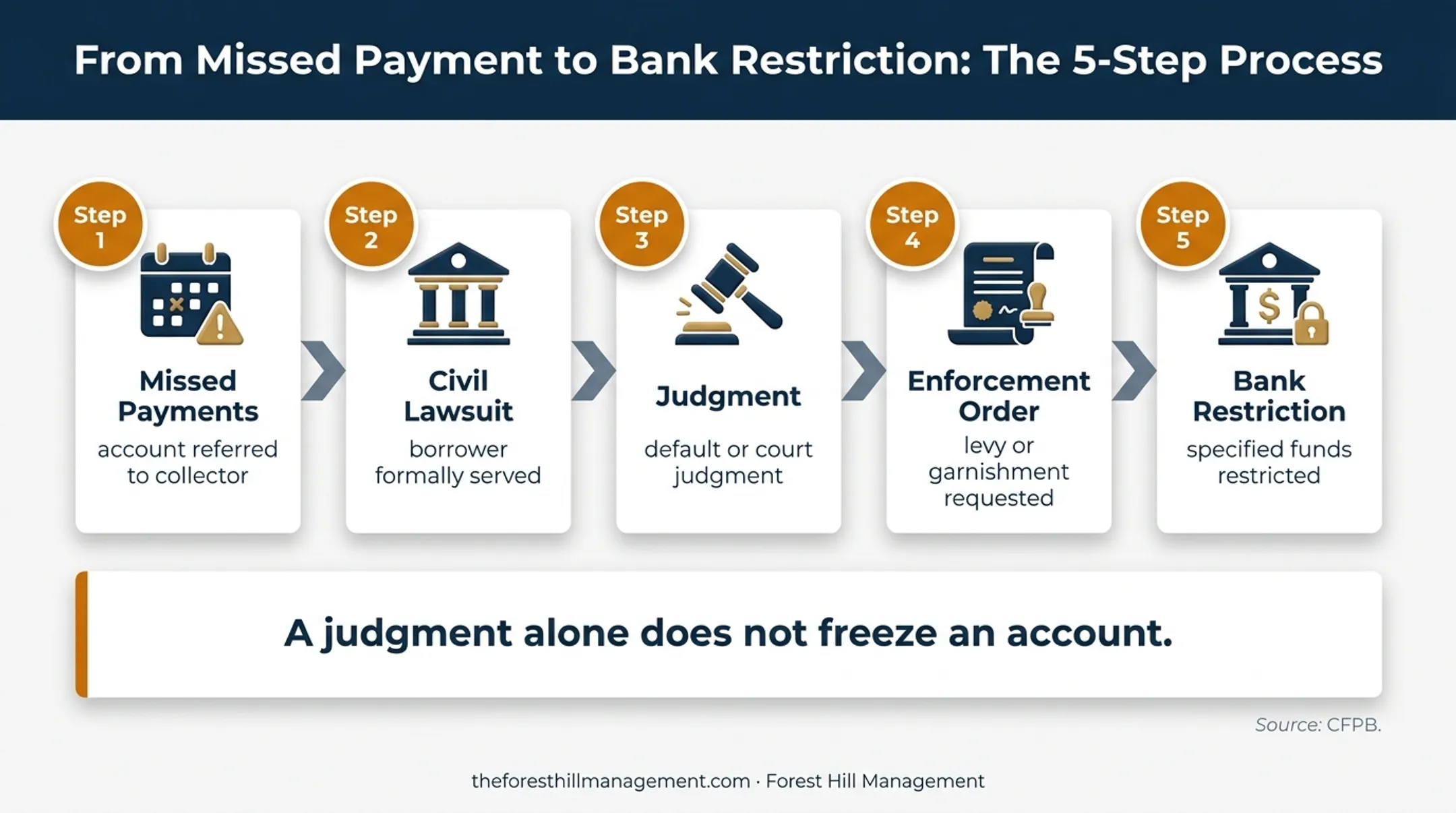
A bank freeze doesn't happen overnight, and it doesn't happen because a collector wants it to. It follows a specific legal sequence:
- You miss payments, and the account gets referred to a debt collector or sold to a debt buyer.
- The creditor or collector sues you in civil court, and you're formally served with the lawsuit.
- You respond, or you don't. If you don't respond, the court can enter a default judgment against you.
- The creditor requests enforcement, such as a writ of execution, bank levy, or garnishment order, once the judgment exists.
- The bank receives and complies with the order, restricting the specified funds.
A judgment itself is just a court's ruling that you owe the money. It doesn't automatically freeze anything. The CFPB explains that a creditor needs a separate court-authorized step, like a levy or garnishment, before a bank actually restricts your account.
What to Request From Your Bank
If you discover a freeze, ask your bank for these specifics:
- Name of the creditor and their attorney
- Court or agency that issued the order
- Case number and date the order was issued
- Amount being restricted
- Deadline for you to respond or file a claim
Advance notice varies widely. In some states, your account may be restricted before you receive any notice from the bank or creditor. That's not unusual, and it doesn't necessarily mean something went wrong procedurally.
Government debts follow different rules. Tax obligations, federally backed student loans, and child support arrears can bypass the ordinary lawsuit-and-judgment process. If your notice mentions one of these, check that agency's procedures for timelines and appeals.
How Long Can a Debt Collector Freeze Your Bank Account?
A bank account freeze has no fixed nationwide time limit. It lasts until the bank releases the funds, the creditor collects the levied amount, the underlying debt is resolved, a court changes the order, or you successfully claim an exemption.
Two Different Timelines
It helps to separate two things people often lump together:
- Time to initiate the freeze — depends on how fast the court processes the case and how quickly the creditor requests enforcement.
- Duration of the freeze — depends on the order's terms, your state's exemption procedures, and how quickly you respond.
Some states build in short "processing windows" before funds move anywhere. New York offers a clear illustration. Under CPLR 5222-a, the bank typically mails the restraint notice and exemption forms within two business days of receiving the order. You then have 20 days from the postmark to file a completed exemption claim.
If you file that claim on time, the bank usually releases the claimed funds eight days after your postmark unless the creditor objects. An objection buys the creditor 21 days to hold the funds while the dispute plays out. If no claim shows up within 25 days of mailing, the restrained funds stay subject to the order.
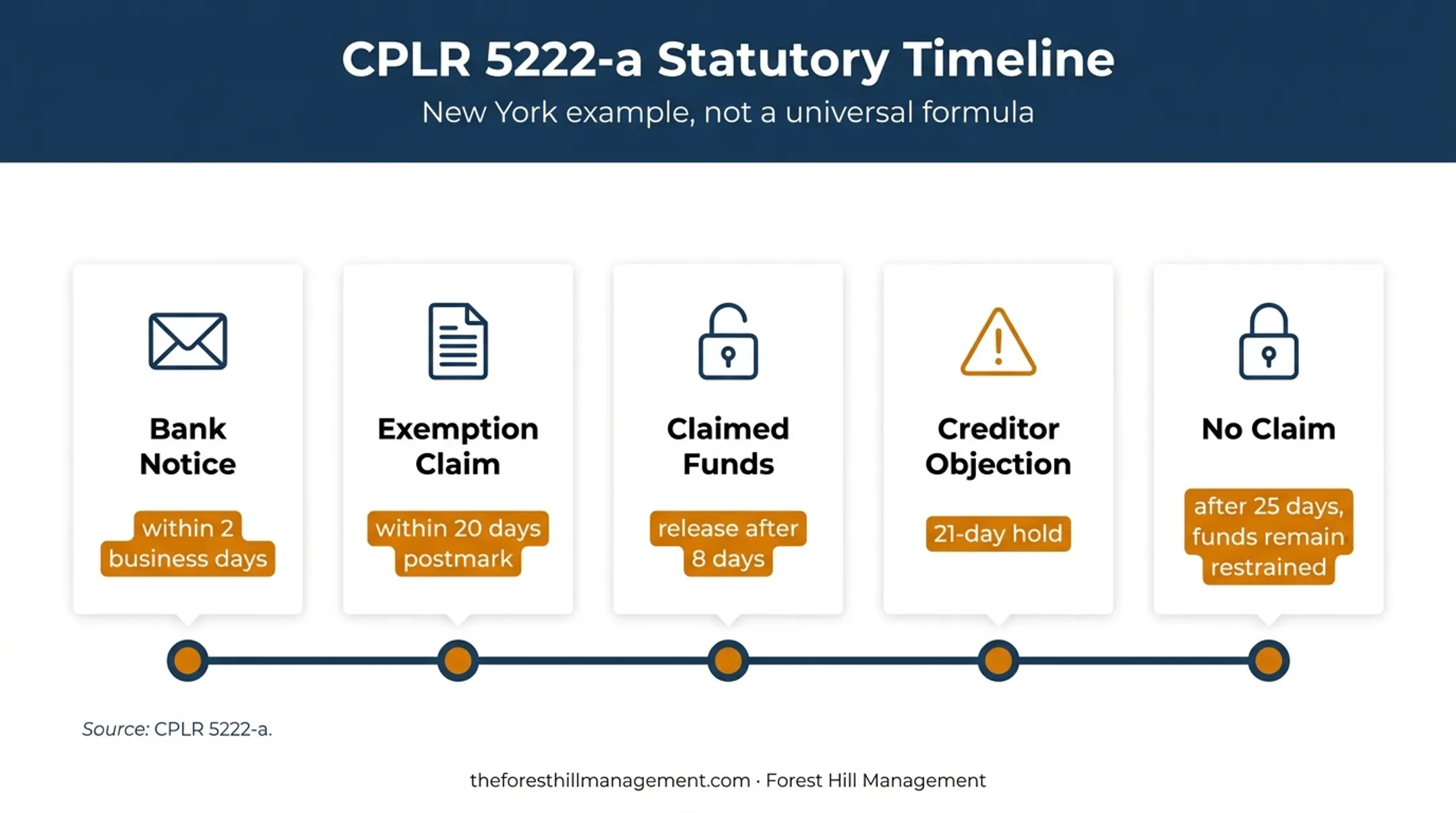
That's one state's example, not a universal formula. California, Texas, and every other state run their own versions of this process with different deadlines, so check your state's specific rules rather than assuming New York's timeline applies to you.
What Prolongs a Freeze
Several things can stretch out how long an account stays restricted:
- Failure to respond to the notice or exemption deadline
- Unresolved or disputed exemption claims
- Multiple judgments against the same account
- Continuing deposits that trigger renewed scrutiny
- Ongoing creditor enforcement of an unpaid judgment
One hard limit: a creditor generally cannot collect more than the judgment amount, plus authorized interest, court costs, and legally permitted fees.
If a levy pulls more than that, excess funds are typically returned. The exact process for recovering overages depends on your state's court procedures.
The Seven-Year Misconception
A lot of people assume debts and judgments simply vanish after seven years. That's a mix-up of three separate things:
- Credit reporting period: Under the Fair Credit Reporting Act, a civil judgment can generally appear on your credit report for seven years from entry, or until the statute of limitations expires, whichever is longer.
- Statute of limitations to sue: This is the window a creditor has to file a lawsuit over the debt in the first place—typically three to six years, depending on the state.
- Judgment lifespan: Once a judgment exists, it doesn't expire with the credit reporting clock. California, for example, generally allows judgments to last 10 years and be renewed, separate from any credit reporting timeline.
None of these rules dictate how long an actual bank freeze lasts. They govern different stages of the process entirely.
What Happens While a Bank Account Is Frozen?
Once a levy or garnishment order takes effect, your access to that account changes immediately.
Transactions typically get blocked. Once the restricted amount is reached, these usually get declined:
- Withdrawals
- Debit card purchases
- Transfers
- Scheduled bill payments
- Checks If a payment bounces because of this, overdraft or returned-payment fees can follow, on top of the frozen balance itself.
New deposits are trickier. Whether payroll or new deposits get swept into the freeze depends on the specific order, your account type, and the source of funds. Some state levies only capture the balance present the moment the bank is served; others can reach money that arrives later while the order stays active. Don't assume either way. Confirm with your bank.
Don't Add Money Without Checking First
It might feel natural to move money into the account to cover bills, but that can backfire if the account is still under an active restraint. Never move money out of an account specifically to dodge a lawful levy. Courts take a dim view of that, and it can create bigger legal problems than the original debt.
Joint accounts add another layer. Whether a co-owner's money gets swept into a freeze depends on how the account is titled, who actually contributed the funds, and your state's specific rules. A joint account doesn't automatically mean 100% of it belongs to the debtor for collection purposes, but proving otherwise takes documentation.
A frozen account isn't a closed account. A temporary restriction, a formal levy, and an eventual turnover of funds to the creditor are three distinct stages. Being frozen doesn't mean the money is already gone.
What Should You Do if a Debt Collector Freezes Your Bank Account?
Speed matters here. The sooner you act, the more options you typically have.
- Call your bank's legal-order or garnishment department and request copies of the notice and the underlying court order.
- Identify the court, case number, and creditor so you can verify the judgment is legitimate and matches your records.
- Confirm your response deadline. These windows are often measured in days, not weeks.
- Pull your recent account statements and trace every deposit—especially protected income such as benefits, wages, or support payments.
- File an exemption claim or motion to dissolve or modify the levy if your state's process allows it, using the specific forms your jurisdiction requires.
While you're sorting out the exemption process, don't ignore your regular bills. Contact employers, landlords, and service providers about any failed automatic payments so you avoid duplicate charges or late fees.
Keep copies of every notice, statement, and phone call log for your records.
Talk to a professional if:
- You suspect the lawsuit was served improperly
- You see a balance that looks wrong or doesn't match your records
- You believe the funds are exempt but the bank hasn't released them
- You suspect identity theft
- You can't cover essential expenses because of the freeze
A consumer-law attorney, legal-aid organization, or bankruptcy attorney can help you understand which of these paths applies to your situation.
If the notice you received identifies Forest Hill Management, use the contact details on that notice to ask about your account or discuss possible resolution options. Forest Hill Management services past-due consumer accounts and can answer account-specific questions, but does not provide legal advice.
Disputes, exemption claims, or challenges to a levy typically require an attorney or your state's legal-aid resources.
What Money May Be Protected From a Bank Levy?
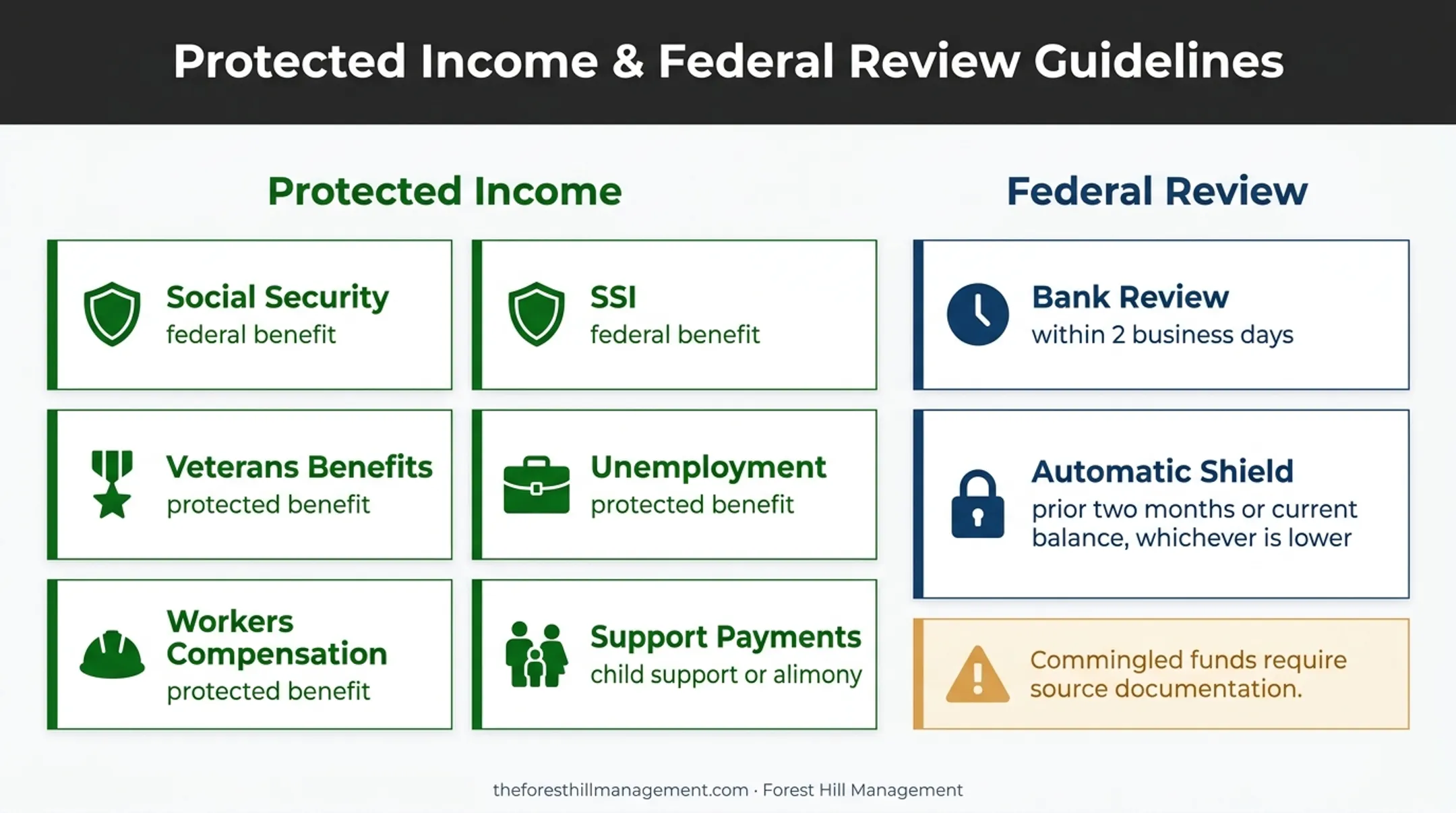
Not every dollar in your account is fair game, even under a valid levy. Federal and state law carve out protections for certain types of income:
- Social Security and Supplemental Security Income (SSI)
- Veterans' benefits
- Unemployment benefits
- Workers' compensation
- Certain pensions
- Child support and alimony payments
That said, protected money can still get temporarily restricted while the bank reviews the levy or while you submit an exemption claim.
Under 31 CFR Part 212, banks generally must review an account within two business days of receiving a garnishment order. They must automatically shield qualifying federal benefits deposited by direct deposit over the prior two months, or the current balance—whichever is lower.
The Commingling Problem
If protected benefits and a regular paycheck land in the same account, tracing which dollars are exempt gets harder. Banks and courts often need documentation showing the source of specific deposits before they release funds.
Exemptions also don't apply uniformly. Certain tax debts, federally backed student loans, and child support or alimony obligations can have different, sometimes narrower, exemption rules than an ordinary credit card judgment. Always check the specific rules tied to the type of debt involved.
To protect your claim:
- Keep award letters or statements showing the source of benefit deposits
- Avoid mixing protected funds with other income when possible
- Request release of protected funds promptly through your bank or the court, following your state's specific procedure
Strong source records and a timely exemption claim give the bank and court a clear basis to release protected funds faster.
Frequently Asked Questions
How long can a debt collector freeze my bank account?
There's no universal nationwide duration. A freeze generally ends when funds are released or transferred to the creditor, the judgment is resolved, or a court modifies or vacates the order.
How long can a debt collector freeze my bank account in Texas?
Texas has its own judgment, garnishment, and exemption procedures that differ from other states. Check current Texas Civil Practice and Remedies Code provisions or consult a Texas attorney.
How long does it take for a debt collector to freeze your bank account?
The time needed to obtain and serve a levy is separate from how quickly the bank restricts the account afterward. Both steps vary by state, court backlog, creditor action, and the type of debt involved.
Can a debt collector freeze my bank accounts?
Generally, a collector needs legal authority, usually a lawsuit and judgment, rather than just making collection calls. Certain government debts and existing judgments follow different, sometimes faster, rules.
Who has the authority to freeze your bank account?
A court or an authorized government agency provides the legal authority behind a freeze. The bank carries out the order, while the creditor or collector requests its enforcement.
What should you do if a debt collector freezes your bank account?
Act quickly if your account is frozen:
- Contact your bank and get a copy of the freeze order
- Note your response deadline and document any exempt funds
- Don't ignore court papers; seek qualified legal help right away