-p-500%20(1).png)
Florida Debt Collection Statute of Limitations: Complete Guide
Need Help Reviewing Your Account?
Contact UsIntroduction
An old debt notice showing up in your mailbox doesn't answer the real question: can this creditor actually sue you? Age alone doesn't decide that. Florida's statute of limitations sets a deadline for filing a lawsuit, but it doesn't erase what you owe.
Many Florida consumers assume a debt "expires" after a set number of years. That's not how it works. The applicable deadline depends on the type of debt, the underlying agreement, when the claim accrued, and your payment history.
This guide breaks down:
- Florida's four-year and five-year limitation periods
- Special categories like hospital bills and judgments
- What can reset or pause the clock
- How credit reporting differs from legal enforceability
- What to do before paying an old account or answering a lawsuit
Key Takeaways
- Florida has no single deadline for all debts; the period depends on claim type and supporting documents
- The lawsuit filing deadline is separate from how long negative marks stay on your credit report
- Never pay, acknowledge, or accept a plan on old debt without knowing the legal consequences
- If served with court papers, respond by the listed deadline; courts don't apply the statute automatically
Florida Debt Collection Statute of Limitations by Debt Type
Florida Statutes § 95.11 sets multiple limitation periods, and the correct one depends entirely on how the debt is legally classified. There's no shortcut that applies to every account type.
Written Instruments vs. Open Accounts
Under Florida Statutes § 95.11, the most common consumer claim periods are:
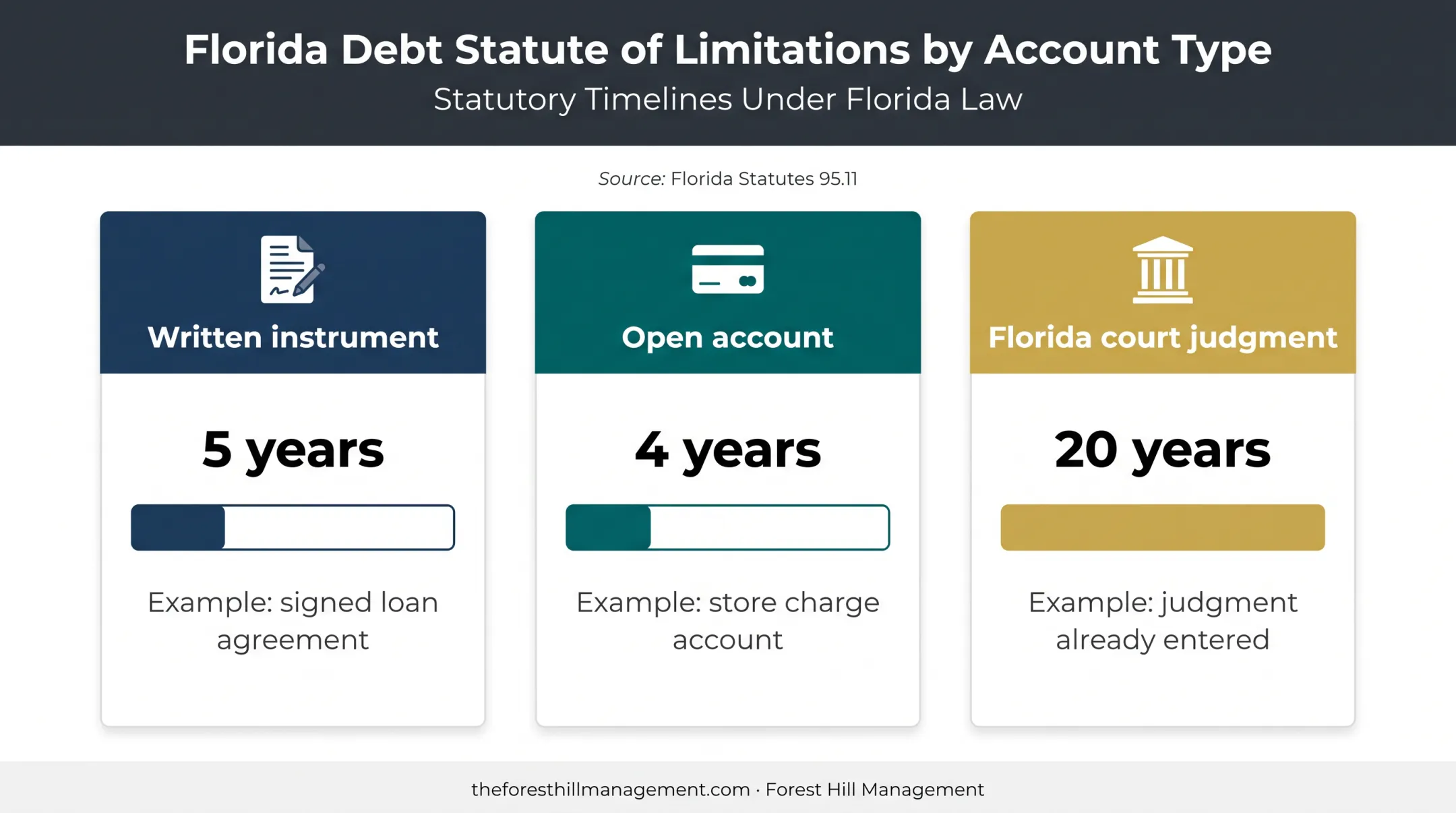
Credit card debt doesn't automatically fall into either category. Whether it's treated as a written-instrument claim or an open-account claim depends on the cardholder agreement, the account records, and how the creditor pleads its legal theory in court.
The Florida Supreme Court addressed this exact issue in Ham v. Portfolio Recovery Associates, examining how an account-stated claim connects to the original agreement. That ruling doesn't mean every card debt gets five years, or four—it means the specific documents and pleaded claim control the outcome.
Special Categories Requiring Separate Review
A few debt types follow entirely different rules:
- Hospital or Chapter 395 facility medical debt: 3 years, measured from the date the facility refers the account to a third party for collection
- Residential mortgage-note deficiency actions: 1 year, tied to specific triggering events like certificate of title issuance
- Installment obligations: accrual depends on missed payment dates and any contractual acceleration clause
Federal Debts Play by Different Rules
Federal student loans and IRS tax debt don't follow Florida's contract-based limitation periods:
- Federal student loans are governed by 20 U.S.C. § 1091a(a), which historically removes ordinary limitations periods for covered federal collection actions
- Federal tax debt generally follows a 10-year collection window from the date of assessment under federal tax law
If you're dealing with either of these, Florida's statute of limitations for consumer contracts simply doesn't apply. These require separate federal analysis.
When Does the Clock Start, Restart, or Pause?
The limitation period doesn't necessarily start on the date you stopped paying. Under Florida law, accrual generally begins when the last element of the legal claim occurs. That date can differ from the charge-off date, the date an account got placed with a collector, or the "last activity" date shown on your credit report.
Reconstructing the Actual Timeline
To figure out when your clock started, you typically need to review:
- The original agreement — note any due date, maturity date, or acceleration clause
- Payment ledger and statements — confirm when the last payment was actually applied
- Default and acceleration notices — check whether the creditor declared the full balance due, and on what date
- Bank records — corroborate the dates shown in collection paperwork
- Court filings — if litigation has started, compare the dates alleged in the complaint
Payments and Acknowledgments: Proceed Carefully
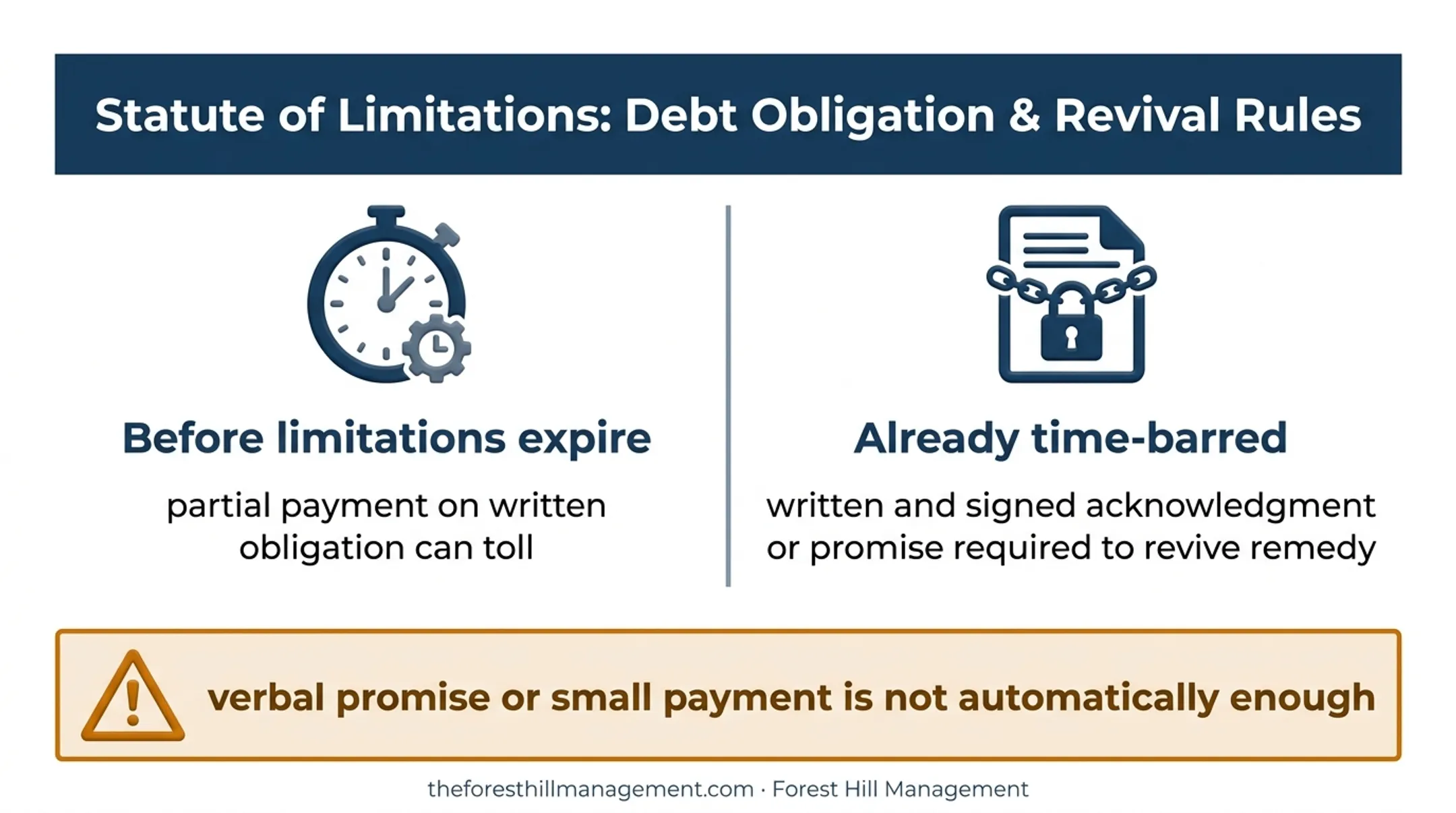
Florida law treats partial payments and written acknowledgments differently depending on timing. If the original limitations period hasn't expired yet, a partial payment on a written obligation can serve as a tolling event under Florida's statutes.
If the debt is already time-barred, Florida Statutes § 95.04 requires a written and signed acknowledgment or promise to pay before a remedy can be revived. A casual verbal promise or a small payment made without understanding the consequences isn't automatically enough to reset anything.
Don't assume a small payment always resets the clock. Don't assume it never does, either. The outcome depends on where you are in the timeline and the exact form of any payment or acknowledgment. Review your account history before making any move.
Here's what generally does and doesn't affect the calculation:
- Selling or assigning an account to a new collector does not create a new limitations date on its own
- Absence from Florida, concealment, or arbitration proceedings may pause the clock under Florida's tolling statute, but each requires fact-specific analysis
- Bankruptcy-related tolling in Florida's statutes is narrowly tied to a specific tax-certificate scenario, not a blanket rule for all consumer debt
Time-Barred Debt, Credit Reporting, and Collection Conduct
"Time-barred" means the deadline to file a lawsuit on the debt may have passed. It does not mean the balance disappears or that every collection issue is automatically resolved. A collector can often still contact you and request voluntary payment. Filing a lawsuit is the specific action that becomes legally restricted.
Credit Reporting Runs on a Different Clock
This is one of the most common points of confusion. According to the Consumer Financial Protection Bureau, most negative information generally stays on a credit report for up to seven years.
For collection accounts and charge-offs, that period is calculated from 180 days after the original delinquency that led to the charge-off, not from when the account was sold or placed with a new collector.
That reporting timeframe is separate from Florida's lawsuit-filing deadline. A debt can be:
- Reportable but no longer eligible for a lawsuit
- Past its reporting window but still legally collectible outside of a lawsuit
- Governed by a judgment that's enforceable for up to 20 years, regardless of the original account's reporting status
What Collectors Can and Can't Say
Federal Regulation F specifically prohibits FDCPA-covered debt collectors from suing or threatening to sue on a debt they know is time-barred. Collectors also can't misrepresent a debt's legal status or use deceptive tactics under the FDCPA and Florida's Consumer Collection Practices Act.
If you're contacted about an older debt, you have the right to request documentation supporting the account. Under federal rules, you can send a debt validation letter to dispute the debt within 30 days of first contact and demand proof before paying anything. Keep records of:
- All collection letters and notices received
- Call logs and dates of contact
- Payment history and account statements
- Your credit reports showing the account status
Judgments Change Everything
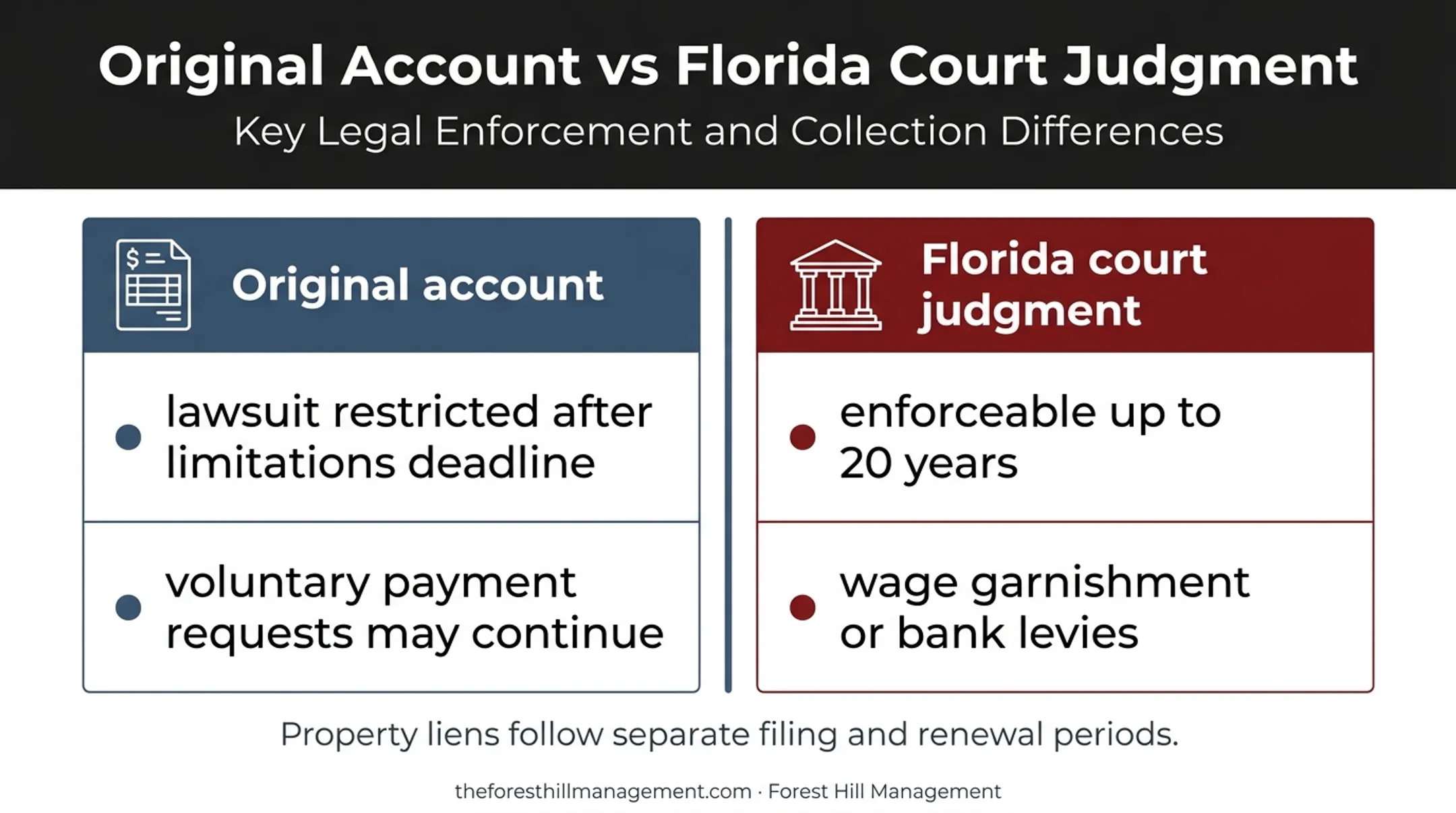
If a creditor already sued you and won, the analysis shifts entirely. A Florida court judgment can be enforced for up to 20 years. That timeline is separate from any lien filed against your property, which follows its own filing and renewal periods.
An unpaid judgment carries collection remedies, such as wage garnishment or bank levies, that differ from an account that's merely approaching or past its original limitation period.
What to Do Before Paying or After Receiving a Florida Debt Lawsuit
Before making any decision about an old debt, work through this checklist:
- Identify the original creditor and confirm who currently owns or services the account
- Confirm the account type — written agreement, open account, medical debt, or something else
- Request account documentation — statements, the original agreement, and payment history
- Locate the last payment and default dates to calculate where the limitations period stands
- Check for prior lawsuits or judgments tied to the account
- Compare your timeline against current Florida law before paying anything
If you've already been served with a lawsuit, don't assume the court will dismiss an old claim automatically. The statute of limitations is an affirmative defense, meaning you generally need to raise it yourself, within your response deadline, or risk losing that argument entirely. Ignoring a summons because "the debt is too old" is one of the costliest mistakes a consumer can make.
Once you have the basics from the checklist, you may still need help pulling records or mapping payment options on a verified past-due account. Forest Hill Management offers account documentation requests, flexible payment plans, and a dedicated line at (888) 471-0109 to help identify the original creditor and review available records.
Forest Hill Management is not a substitute for a Florida attorney. Whether a specific claim is time-barred requires legal analysis of your account and the current statute.
When to Seek Legal Advice
Talk to a qualified Florida attorney if you're facing any of the following:
- An active lawsuit or a judgment already entered against you
- A garnishment notice or threat
- A disputed account where you don't recognize the debt
- Uncertainty about your payment history or the exact accrual date
- A bankruptcy-related complication
- A debt involving a mortgage deficiency, federal student loan, or hospital-referral rule
Frequently Asked Questions
How long can a debt collector legally pursue old debt in Florida?
It depends on the debt's legal classification: generally four or five years for ordinary consumer debts, longer for judgments. Phone calls and letters may continue, but filing a lawsuit is restricted once the deadline passes.
Does debt go away after 7 years?
No. Seven years refers to how long most negative information stays on your credit report, not Florida's lawsuit deadline. The underlying balance doesn't automatically disappear when either timeframe expires.
Can a debt from 20 years ago be collected?
Possibly, depending on whether a judgment was entered, whether the clock was tolled or revived through a signed acknowledgment, or whether federal rules apply. Review court records and account documentation before assuming the debt is uncollectible.
What happens if you never pay collections?
Consequences can include continued credit reporting, ongoing collection contact, and a lawsuit if the debt is still within the limitations period. If a creditor wins a judgment, enforcement tools like wage garnishment can follow.
What happens if a debt collector sues you and you have no money?
Don't ignore the summons. Missing your response deadline can lead to a default judgment. Review defenses and exemptions, and seek qualified legal guidance on judgment and garnishment risks before the deadline.