-p-500%20(1).png)
CFPB Finalizes Rule to Remove Medical Debt from Credit Reports
Need Help Reviewing Your Account?
Contact UsThe Consumer Financial Protection Bureau finalized a rule in January 2025 that would have stripped most medical debt from the credit reports lenders use to make decisions. Then, in July 2025, a federal court vacated it. If you've heard "medical debt is banned from credit reports," that's not accurate today. There's no nationwide federal ban currently in effect.
That distinction matters because medical debt rarely behaves like other consumer debt. A surprise ER visit, an insurance claim denied over a coding technicality, or a billing error can land in collections through no fault of your own. Unlike a missed credit card payment, a medical collection often reflects a broken billing process more than your willingness to pay.
This article walks through what the CFPB's rule would have changed, why a Texas court rejected it, which protections still apply, and what you can actually do if a medical collection shows up on your report.
Key Takeaways
- CFPB medical-debt rule finalized Jan 2025 was vacated in July 2025; confirm current status first.
- Nationwide bureaus exclude paid medical collections, delay unpaid ones a year, and drop small balances.
- California, Colorado, New York, and D.C. enforce medical-debt rules independent of federal action.
- Review all three credit reports, keep records, and dispute errors with the bureau and furnisher.
What the CFPB's Medical-Debt Rule Was Designed to Do
The final rule, published in the Federal Register in January 2025, targeted two connected problems. First, it would have removed a longstanding regulatory exception that let creditors factor medical debt into credit eligibility decisions. Second, it would have generally barred consumer reporting agencies from including medical debt on reports furnished to creditors for those decisions, with some carve-outs.
That's a meaningful distinction: the rule addressed both the presence of medical debt in a report and how creditors could use it. It didn't touch medical information broadly, and it never claimed to erase the underlying bill.
The Numbers Behind the Proposal
The CFPB built its case around real data. In its 2024 rulemaking materials, the Bureau estimated that roughly 15 million people carried a combined $49 billion in medical bills showing up in the credit-reporting system.
An earlier 2014 CFPB study found that consumers whose collections were mostly medical had delinquency patterns similar to people scoring about 10 points higher, suggesting medical collections weren't as predictive of future repayment as other debt types.
Based on that research, the CFPB projected that finalizing the rule could:
- Raise affected consumers' credit scores by an average of 20 points
- Enable roughly 22,000 additional mortgage approvals
These were forecasts tied to the proposed rule, not guaranteed outcomes. The rule was vacated before those effects could materialize.
Why the Rule Was Vacated—and What That Means Now
The Legal Timeline
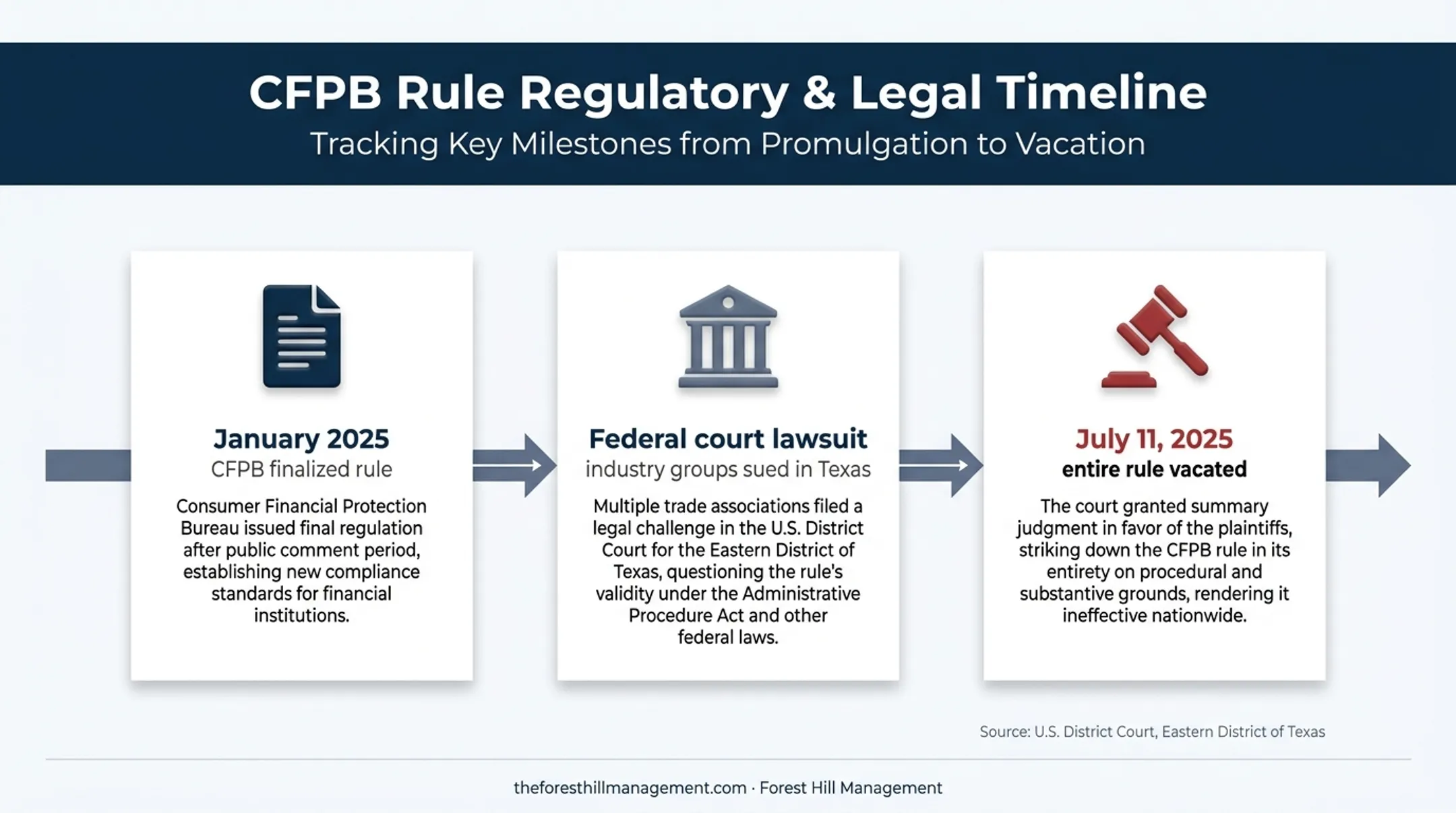
The CFPB finalized its rule in January 2025. Industry groups, including a credit union league and a consumer data trade association, quickly sued in federal court in Texas. Rather than defending the rule at length, the CFPB's litigation position shifted, and the parties reached a consent judgment.
On July 11, 2025, Judge Sean D. Jordan of the U.S. District Court for the Eastern District of Texas entered a final judgment vacating and setting aside the entire rule, sending the matter back to the CFPB.
As of this writing, no confirmed appeal has changed that outcome. Litigation status can shift, so check the CFPB newsroom, the Federal Register, and the court docket before assuming otherwise.
What "Vacated" Actually Means
Vacating a rule isn't the same as Congress repealing a law or a higher court setting binding nationwide precedent. It means one federal district court found the rule invalid and eliminated it entirely.
In practical terms:
- No part of the rule is enforceable today
- A later court ruling, agency action, or statute would be required to revive it
- The decision is not automatic nationwide appellate precedent
The court's central reasoning: the Fair Credit Reporting Act already permits furnishing and using appropriately coded medical debt information for certain credit purposes. The judge concluded the CFPB's broad restrictions conflicted with that existing framework and exceeded the Bureau's rulemaking authority.
The opinion also included comments suggesting federal law would preempt state restrictions on reporting medical debt. Consumer advocates describe those comments as dicta (remarks not necessary to the ruling), since no specific state statute was actually challenged in the case.
A separate October 2025 CFPB interpretive rule takes a broader preemption view, but the Bureau itself says that interpretation carries no binding legal effect. Treat state-law questions as unresolved rather than settled either way.
What Protections May Still Apply to Medical Debt
Losing the federal rule doesn't mean medical debt reporting reverted to a free-for-all. Two separate layers of protection still operate independently of the CFPB rule's fate.
Voluntary Bureau Policies
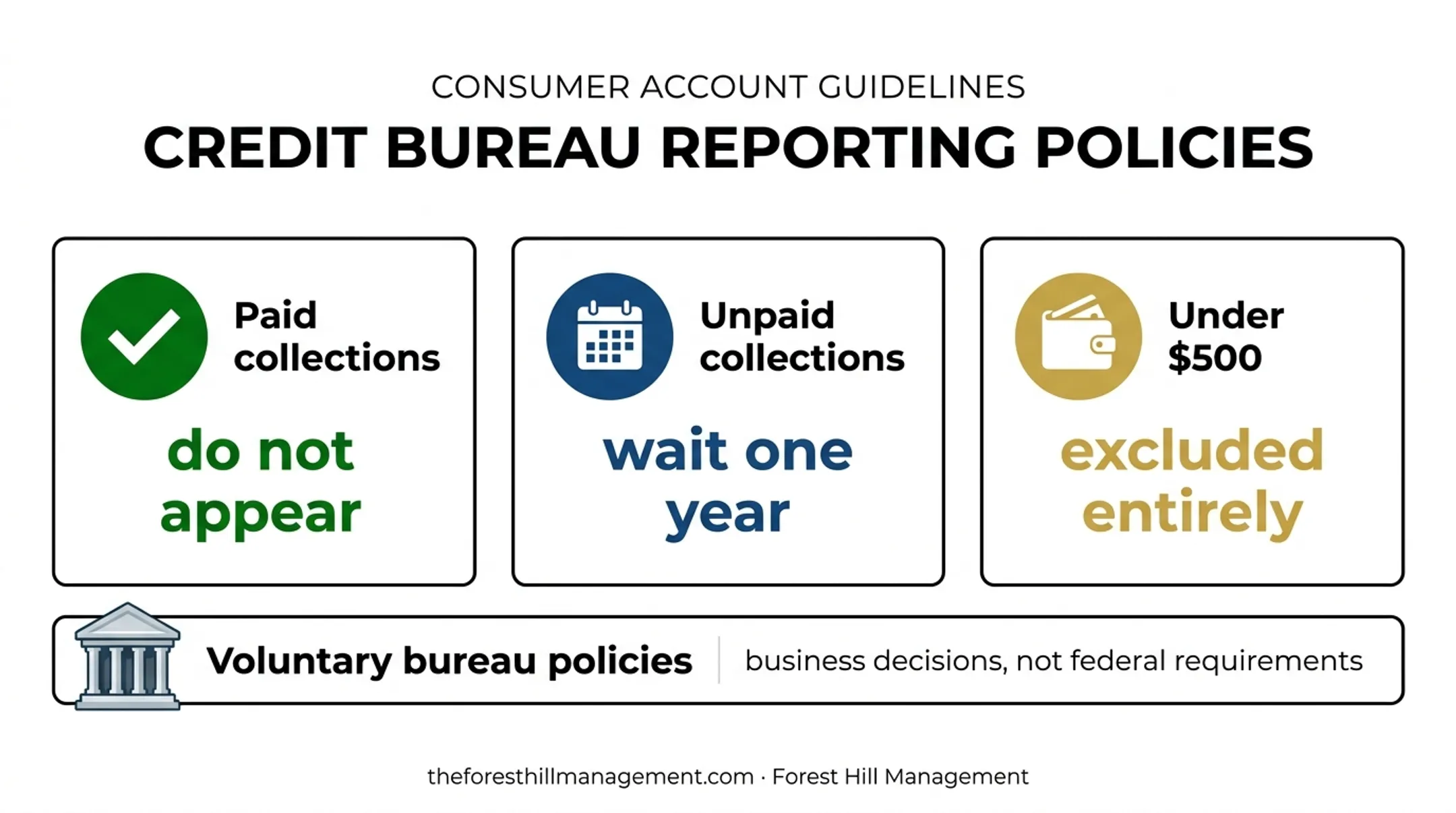
Equifax, Experian, and TransUnion jointly adopted these practices starting in 2022 and 2023:
- Paid medical collections no longer appear on credit reports at all
- Unpaid medical collections wait a full year before appearing (up from six months)
- Collections with an initial reported balance under $500 are excluded entirely
That last point matters: it's the initial reported balance that counts, not a later reduced amount. These are business decisions the bureaus made voluntarily, not requirements tied to the vacated rule, so they could theoretically change again.
State-Level Restrictions
Several states have passed their own laws regulating medical-debt reporting, independent of anything the CFPB does:
Each law targets different parties: sometimes the reporting agency, sometimes the healthcare provider or furnisher.
For a current, jurisdiction-specific breakdown, NCLC's medical debt tracker is a useful resource. Check your own state's law rather than assuming another state's protection applies to you. Given the unsettled preemption question, anyone facing a specific dispute should consider talking to a consumer-law attorney.
What Consumers Should Do if Medical Debt Appears on a Credit Report
Finding a medical collection on your report isn't the end of the story. Here's a practical sequence to follow.
- Pull all three reports from AnnualCreditReport.com, the only authorized free source. It currently offers weekly access from each bureau.
- Identify the furnisher and reporting date for the collection account.
- Compare it against your itemized provider bill and insurance explanation of benefits.
- Save copies of everything: bills, EOBs, letters, and any prior correspondence with the provider or collector.

Common Problems to Watch For
- Duplicate accounts for the same bill
- Wrong balances or amounts that don't match your paperwork
- Accounts belonging to someone else (often a mixed-file error)
- Paid or settled debts still showing as open
- Insurance payments that were never credited
- Debts the furnisher can't actually verify when challenged
If you spot an error, dispute it with both the credit bureau and the original furnisher. Include specific documentation, keep proof of delivery, and follow up on the investigation results. CFPB guidance recommends this dual-track approach rather than contacting just one party.
Before paying anything, confirm:
- The debt is accurate
- Who currently owns the account
- Whether hardship programs or payment plans are available
Paying an accurate medical collection does not automatically guarantee removal. Some bureaus remove paid collections voluntarily, but policies can change, so get any resolution agreement in writing.
If your account has already been placed with a receivables management company, resources like what to do after receiving a debt collection letter or how to get medical debt forgiven can walk through verification and negotiation steps in more detail.
A company such as Forest Hill Management, which services past-due accounts assigned by original creditors, can typically help explain communication options, payment arrangements, or documentation requests for a specific account.
No servicer can promise deletion of accurate information from your credit report, replace legal advice, or guarantee a score increase. Those outcomes depend on bureau policy, state law, and your individual account details.
If a dispute goes unresolved, or you suspect a violation, escalate:
- File a complaint through the CFPB's complaint portal
- Contact your state attorney general's consumer protection office
- Consult a qualified consumer-law attorney
If something feels off entirely, like you don't recognize the debt at all, resources on reporting fake debt collectors and scams or California's specific debt collection rights can help you figure out your next move.
Frequently Asked Questions
Are medical debts being removed from credit reports?
Not automatically. The CFPB's rule aimed to remove most medical debt from reports used in credit decisions, but a federal court vacated it in July 2025. Voluntary bureau policies and some state laws still limit certain accounts.
Does the CFPB have authority over medical debt collection?
The CFPB oversees many consumer-finance and credit-reporting practices generally, but a federal court ruled it exceeded its authority with this specific rule. Those are two separate legal questions.
Do medical collections affect your credit score?
Some still can, depending on the bureau's current policy, the account's age and balance, and applicable state law. Check all three of your reports. Treatment can differ between bureaus.
Will a medical collection be removed from my credit report if I pay it?
Not universally, but current bureau policies often remove paid medical collections voluntarily. Confirm the specific policy in place before paying, since these practices can shift.
Should I pay a medical bill that went to collections?
Verify the balance and confirm who currently owns the debt first. Check for billing or insurance errors and ask about hardship assistance. Consider legal advice if anything seems disputed.
How long can you not pay a medical bill before it goes to collections?
There's no single nationwide deadline. It depends on your provider's contract, prior notices, and state law. Review your billing statements and any collection letters for the specific timeline that applies to you.