-p-500%20(1).png)
CFPB 2024 Advisory Opinion on Medical Debt Collection
Need Help Reviewing Your Account?
Contact UsIntroduction
In 2022 alone, consumers filed roughly 8,500 complaints with the CFPB about medical debt collection.
Many described bills they'd already paid, charges insurance should have covered, or amounts tied to services they never received, according to the CFPB's own reporting on medical debt collection issues.
That pattern is exactly what the CFPB's October 2024 Medical Debt Collection Advisory Opinion tried to address. Industry groups pushed back hard, and by mid-2025 the Bureau had withdrawn the opinion and signaled it wouldn't reissue it.
So where does that leave things? This article breaks down what the 2024 opinion said, why it was challenged, and what its withdrawal does (and doesn't) change.
One point up front: withdrawing an advisory opinion doesn't suspend the FDCPA, Regulation F, the FCRA, or state consumer-protection law.
Key Takeaways
- The 2024 opinion applied existing federal debt-collection law; it was not a new statute.
- Industry groups said it set new requirements without notice-and-comment rulemaking.
- Withdrawal doesn't mean disputed medical debts are now automatically collectible.
- Statutes, regulations, court decisions, and state law still control, with or without the opinion.
- Consumers should review bills and collection notices carefully before they pay or file a dispute.
What Did the CFPB's 2024 Medical Debt Collection Advisory Opinion Address?
The CFPB issued the opinion on October 1, 2024, and published it in the Federal Register three days later at 89 Fed. Reg. 80715. Despite the "advisory opinion" label, it wasn't a new medical-debt statute. It was the Bureau's interpretation of obligations already built into the Fair Debt Collection Practices Act (FDCPA) and Regulation F.
Much of that interpretation centers on a practical problem: medical balances are harder to verify than ordinary consumer debts.
Why Medical Bills Are Hard to Verify
Medical accounts are messier than a typical credit card balance. Verifying what's actually owed can involve:
- Insurance payments that haven't been reconciled with the provider's ledger
- Government-program payments (Medicare, Medicaid) applied after billing
- Coding errors or billing adjustments made after the account was sent to collections
- Disputed services, where the patient contests what was actually performed
- Gaps between a provider's internal records and the data a collector receives
Those gaps are what pushed the CFPB to treat medical debt as a distinct collection risk under existing FDCPA rules.
Examples of Conduct the CFPB Flagged
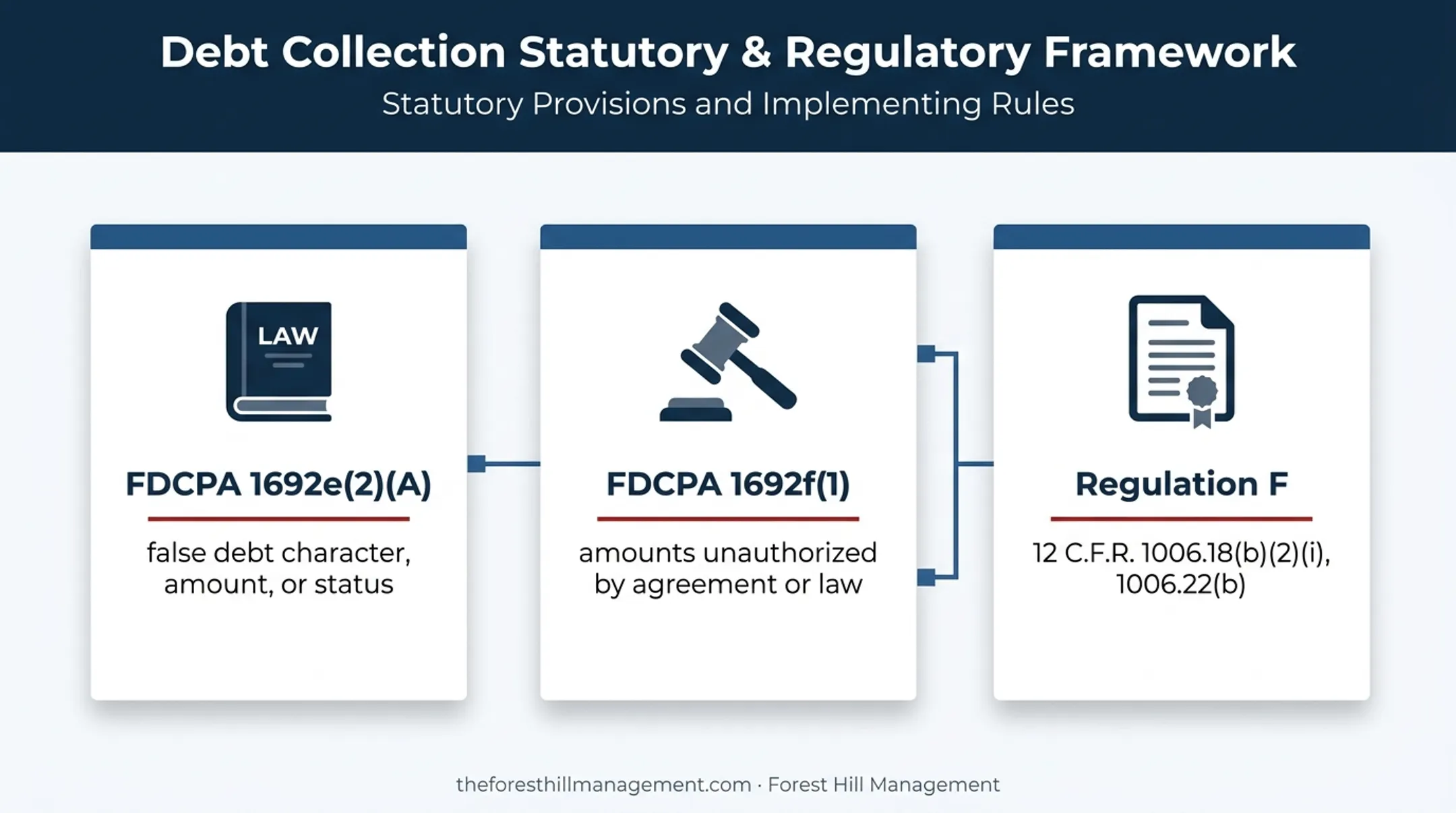
The opinion cited 15 U.S.C. § 1692e(2)(A), which bars falsely representing a debt's character, amount, or legal status, and § 1692f(1), which bars collecting amounts not authorized by agreement or law. It also referenced the matching Regulation F provisions (12 C.F.R. §§ 1006.18(b)(2)(i), 1006.22(b)).
Examples of potentially deceptive or unfair conduct included:
- Pursuing an amount already paid by the patient, an insurer, or a government payor
- Billing a patient for charges legally assigned to someone else
- Seeking amounts above legal limits, including protections under the No Surprises Act
- Charging for services never provided, or billing a costlier service than what was actually delivered
The Bureau also flagged substantiation concerns. Collectors need a reasonable basis before asserting a debt is owed, and should not treat an uncertain or disputed balance as final or legally established without qualification. The scenarios above are illustrative, not a complete catalog of unlawful practices.
How Do Federal Debt-Collection and Credit-Reporting Protections Apply?
Three federal frameworks matter here, and they don't overlap perfectly:
The FDCPA generally applies to entities meeting the statutory definition of "debt collector," not every creditor or provider handling its own account. That distinction matters because a hospital billing department collecting its own accounts may fall outside FDCPA coverage even though the same conduct by a third-party collector wouldn't.
What Consumers Can Actually Do
If you receive a medical collection notice, take these steps:
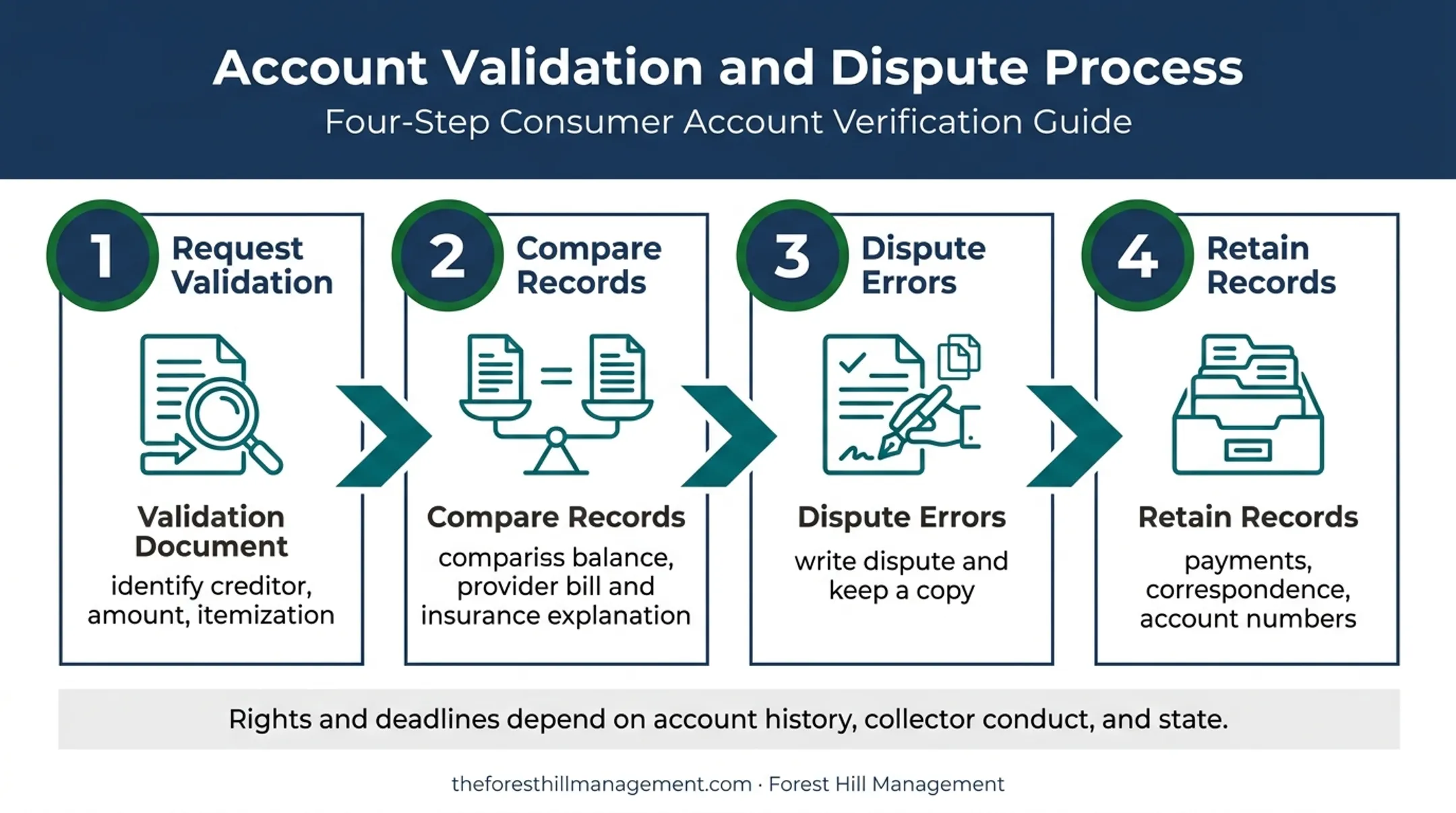
- Request validation where applicable, requiring the collector to identify the creditor, amount, and itemization
- Compare the notice against your provider bill and insurance explanation of benefits
- Dispute anything inaccurate, in writing, and keep a copy
- Retain records of payments, correspondence, and account numbers
Those steps address collector conduct. Credit-reporting rules for medical debt move on a separate track from this advisory opinion.
A January 2025 Regulation V rule restricting medical-debt reporting was vacated in its entirety by a federal court in July 2025. Major credit bureaus have also changed voluntary policies over the years. Check current bureau and CFPB guidance before assuming any specific reporting rule still applies.
Rights and deadlines here depend heavily on account history, the collector's specific conduct, and your state, so treat this as a starting framework rather than a complete answer.
Why Was the Advisory Opinion Challenged, and What Is Its Current Status?
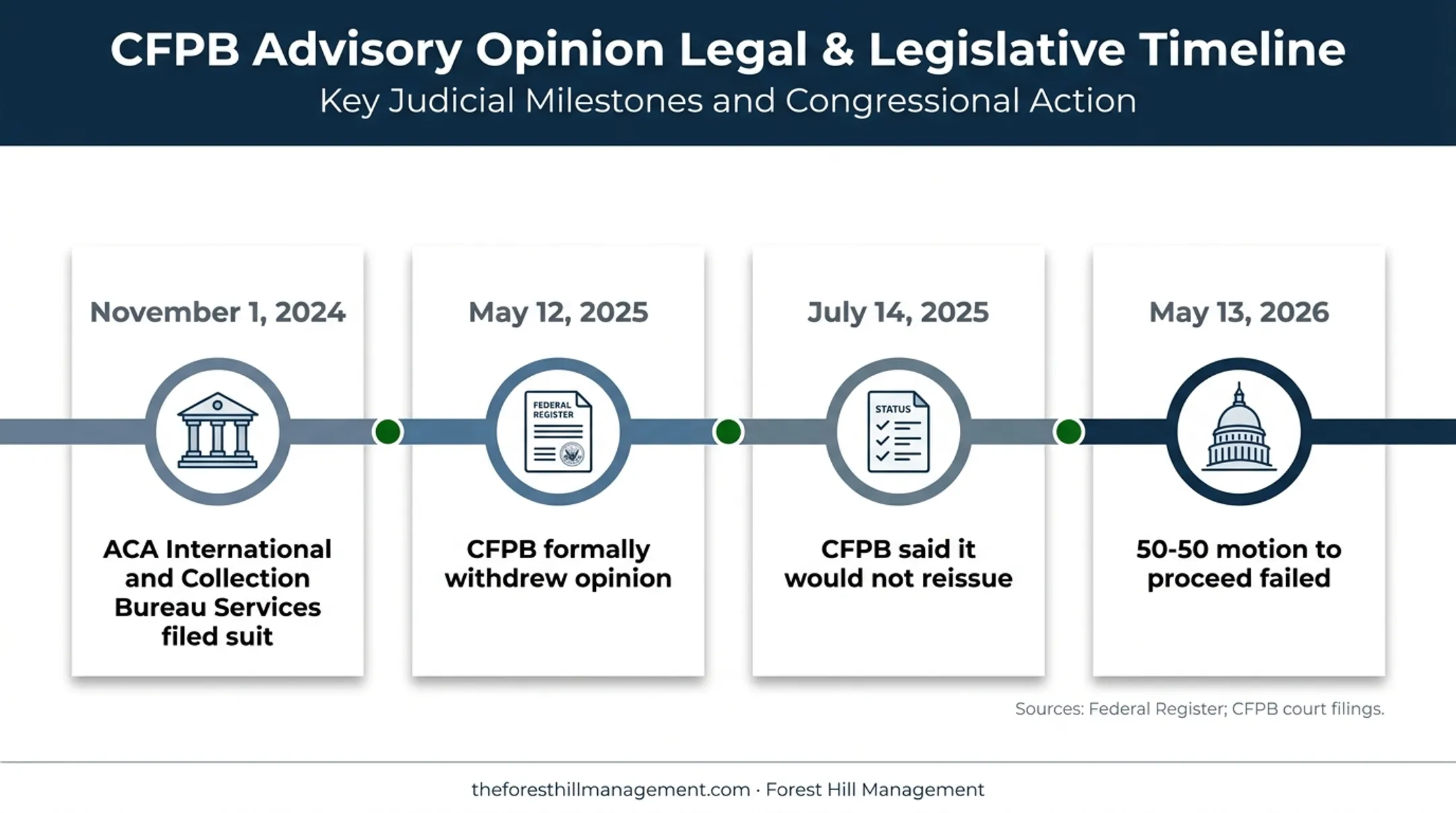
ACA International and Collection Bureau Services filed suit against the CFPB in the U.S. District Court for the District of Columbia (No. 1:24-cv-03118-DLF) on November 1, 2024. Their central argument: the CFPB used an advisory opinion to impose new substantive requirements on the industry without going through the Administrative Procedure Act's notice-and-comment rulemaking process.
That's an allegation from the plaintiffs, not a court finding against the CFPB.
Around the same time, a congressional resolution (H.J.Res.220, introduced November 13, 2024) sought to disapprove the opinion outright. It never became law, but it showed how divisive the opinion had become among consumer advocates, healthcare stakeholders, and collection-industry groups.
The Withdrawal Timeline
- April 11, 2025 — CFPB and plaintiffs jointly told the court the Bureau planned to revoke the opinion and requested a stay
- May 12, 2025 — The CFPB formally withdrew the opinion via Federal Register notice 90 Fed. Reg. 20084
- July 14, 2025 — The CFPB filed a status report stating it "does not intend to reissue" the opinion, while plaintiffs indicated they'd voluntarily dismiss their claims
Notably, a separate congressional effort in 2026 (S.J.Res.141) tried to disapprove the withdrawal itself. The Senate motion to proceed failed on a 50-50 vote on May 13, 2026, meaning the withdrawal stands, at least for now.
What to watch next:
- Possible future CFPB rulemaking on medical debt
- Additional court activity tied to the underlying litigation
- Further congressional action
- State-level regulation filling the gap
None of these outcomes are guaranteed, so don't assume the current status is permanent.
What Does the Advisory Opinion's Withdrawal Mean for Consumers and Collection Businesses?
Withdrawal removes the CFPB's specific guidance document. It does not decide whether any particular collection practice violates the FDCPA, Regulation F, the FCRA, or state law. Those underlying rules are still the ones that matter.
A Practical Checklist for Consumers
Before paying or disputing a medical collection account:
- Compare the collection notice against your original provider bill
- Confirm insurance and government-payor statements match what's being collected
- Verify the services listed were actually received
- Check for billing adjustments or write-offs that should reduce the balance
- Document everything: dates, account numbers, payment confirmations, and correspondence
Don't ignore a lawsuit summons, and don't assume a dispute automatically pauses all collection activity. Some protections apply only to specific, timely disputes.
For Collectors, Providers, and Portfolio Holders
Compliance teams shouldn't treat a withdrawn advisory opinion as the end of the analysis. Ongoing priorities should include:
- Auditing account-level substantiation before pursuing payment
- Confirming payment-posting and insurer/government-payor updates are current
- Verifying service records and coding accuracy
- Reviewing how representations appear in letters, calls, portals, and credit reporting
- Handling disputes promptly under Regulation F and FCRA furnisher rules
Data security matters here too. Medical-account information carries sensitivity beyond a typical consumer debt, so collectors should reference applicable federal and state privacy requirements rather than assuming HIPAA alone governs FDCPA compliance.
Forest Hill Management, a receivables-management company servicing past-due consumer accounts since 2020, builds portfolio work around this kind of account-specific review rather than blanket assumptions. Acquisition due diligence and personalized account servicing are designed to support regulatory adherence—not generic collection tactics.
That is not a substitute for legal advice, and it does not guarantee any outcome on a specific account. It does reflect where compliance-minded servicers are heading, with or without the advisory opinion.
If you're dealing with a disputed or complicated medical account, consider talking to a qualified consumer-law attorney, a legal-aid organization, or your state regulator before making a decision you can't easily undo.
Frequently Asked Questions
Can the CFPB remove collections from my credit report?
Not directly. The CFPB does not delete individual credit report entries. You can dispute inaccurate information with the credit reporting agency and the furnisher, and you can submit a complaint to the CFPB.
Do I have to pay my debt if it was sold to a debt collector?
Selling or transferring an account doesn't by itself erase a valid obligation. Request account information, verify the amount and ownership, and dispute anything inaccurate before paying.
Can medical debt affect my credit report?
Yes. Medical debt may appear on your report under current FCRA rules, credit reporting agency policies, and state law. Check your report regularly and dispute anything inaccurate, incomplete, or not legally reportable.
What is the most common violation of the FDCPA?
No single violation ranks as most common nationwide. Frequent examples include misleading statements about a debt, improper communication practices, and attempts to collect amounts not actually owed.
What type of debt is not covered by the FDCPA?
Coverage depends on the statutory definition of "debt" and whether the collector qualifies as a "debt collector." Business debts generally fall outside the FDCPA, though other federal or state protections may still apply.